


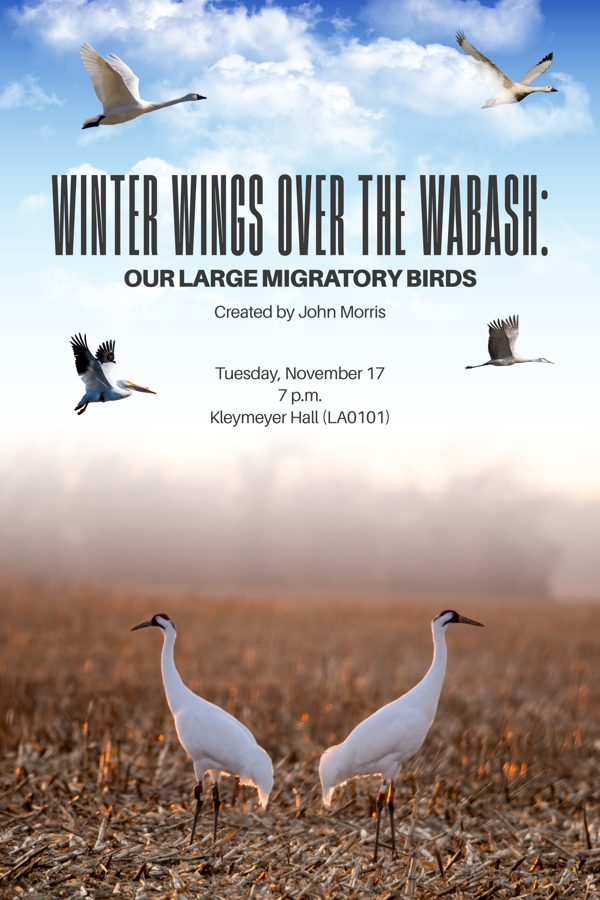
“Winter Wings over the Wabash” to premiere November 17 at USI
New documentary by USI's John Morris captures one of the Midwest's most remarkable wildlife migrations
The skies and wetlands of southwest Indiana and western Kentucky provide a seasonal home to hundreds of thousands of migratory birds, creating one of the Midwest’s most remarkable wildlife spectacles. A new documentary by John Morris, Senior Instructor in Radio and Television, brings this extraordinary natural phenomenon into focus with the first public screening of "Winter Wings over the Wabash: Our Large Migratory Birds" at 7 p.m. Tuesday, November 17, in Kleymeyer Hall (LA 0101) located in the lower level of the Liberal Arts Center on the University of Southern Indiana campus.
Created over a more than two-year span, the documentary explores the diversity of large migratory birds that travel through or winter in the region, including vast flocks of Snow Geese, Tundra and Trumpeter Swans, American White Pelicans, Sandhill Cranes and the endangered Whooping Crane. Through stunning wildlife imagery and insights from wildlife experts, the film examines why these birds are drawn to the region, the challenges they encounter along their migratory journeys and the conservation efforts working to protect the habitats they depend on.
The documentary features four key wildlife areas: Sloughs Wildlife Management Area west of Henderson, Kentucky; Hovey Lake Fish and Wildlife Area west of Mount Vernon, Indiana; Cane Ridge Wildlife Management Area west of Princeton, Indiana; and Goose Pond Fish and Wildlife Area west of Linton, Indiana. Morris also conducted additional research at wildlife areas in northwest Indiana; near Seymour, Indiana; and near Huntsville, Alabama.
“For years, I didn’t know that this migration was happening every year, often just miles from where I live,” Morris said. “It’s an incredible experience to see each of these birds in wildlife areas that are critical to their survival. It’s almost beyond belief to look up and see over 100,000 Snow Geese leaving the lake and heading to area farm fields, to hear the incredible call of thousands of Sandhill Cranes, and to learn that we actually have pelicans in this area.”
Morris hopes the documentary will encourage viewers to recognize the ecological significance of the region’s wildlife habitats and the importance of preserving them.
“Then there is the beauty of swans in the air and on the lake, and then to see the endangered Whooping Crane call Indiana home during the winter,” he said. “We need to learn about these and work to protect these vital areas.”
Morris serves as general manager of 95.7 The Spin, USI’s award-winning student radio station. He teaches courses in broadcasting, audio production, sportscasting, broadcast management and media writing while mentoring students in hands-on radio and television production. He has announced more than 1,000 collegiate sporting events across soccer, volleyball, basketball, baseball and softball, including broadcasts on radio and ESPN+.
In 2023, Morris received the College of Liberal Arts Excellence in Teaching Award in recognition of his commitment to student learning and excellence in the classroom. Under his leadership, USI students and 95.7 The Spin have earned numerous honors in state and national competitions. Outside the classroom, Morris has pursued his interest in nature through photography and videography, combining his passion for wildlife with his experience in visual storytelling to create the documentary.
The project received support from two College of Liberal Arts awards. The College of Liberal Arts Faculty Development Award provided funding for equipment, while the Liberal Arts Research Award supported a one-class reduction in Morris’ teaching load for a semester, allowing him additional time in the field to capture wildlife footage.
Through immersive imagery and a closer look at the region’s natural resources, "Winter Wings over the Wabash: Our Large Migratory Birds" invites viewers to discover a remarkable migration happening in their own backyard and consider the role local communities can play in protecting it.