


Ciholas and USI CAR Improve CUWB Tag Manufacturing
When Ciholas Inc., a Newburgh, Indiana-based manufacturer identified opportunities to improve the production of its CUWB® Ultra-Wideband (UWB) tags, the company partnered with the University of Southern Indiana's Center for Applied Research (CAR).
The CUWB system is a highly accurate indoor tracking system that uses ceiling-mounted "anchors" to identify the location of individual tags wherever they might be located inside the building. The tags are very small, making them easily mounted to boxes and packages, or even worn on one's clothing. These can be used for a wide variety of purposes, such as tracking inventory in a warehouse, multiple actors in a stage play, or tourists inside a museum. As Ciholas saw increased demand for its tracking system from a variety of customers, they quickly realized the need for a more efficient process to assemble the tags.
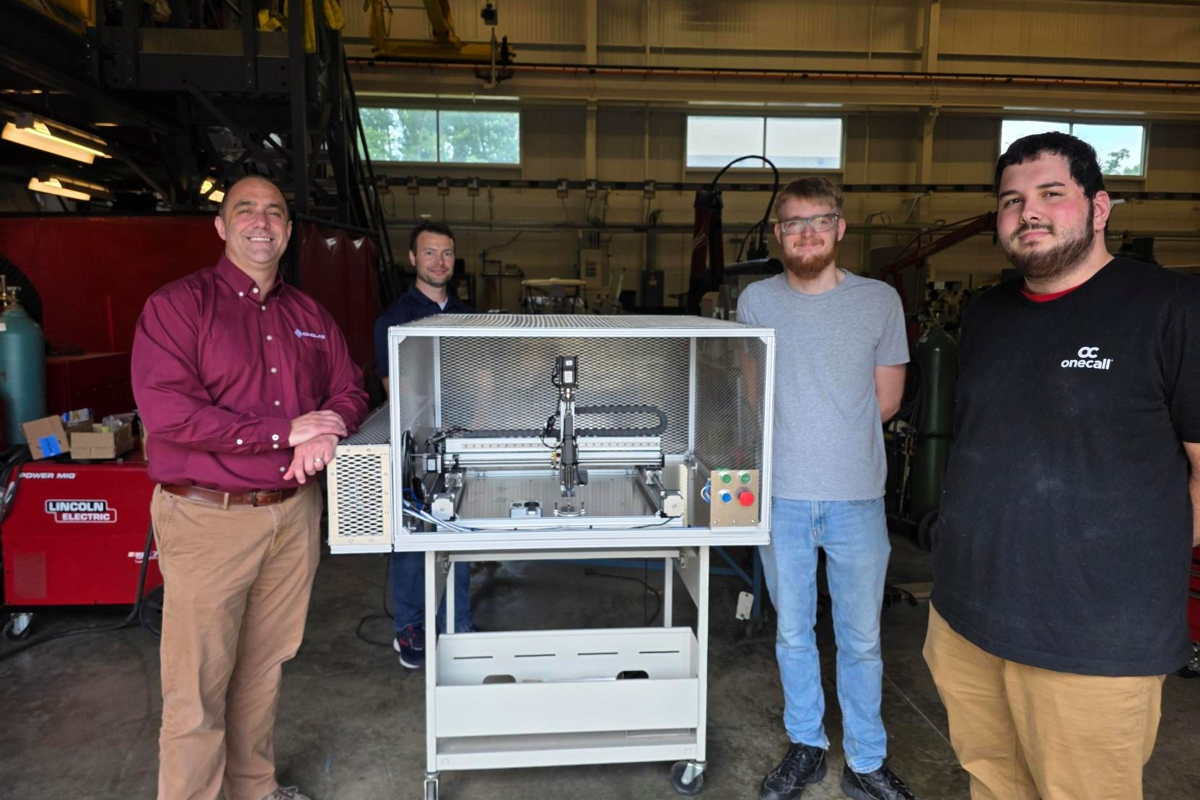
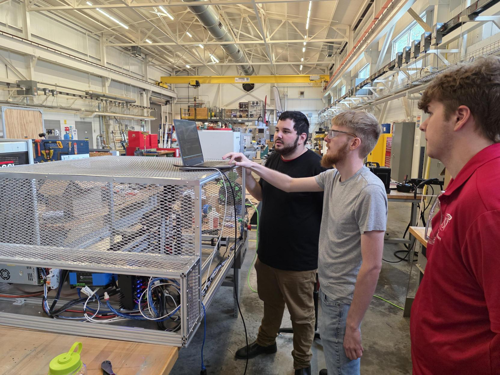
Working closely with Ciholas engineers, CAR's professor-guided student team designed and built a self-calibrating three-axis gantry system that integrated with an existing syringe dispenser. The team developed a Python-based operator interface, implemented automatic calibration using a touch probe, and created custom fixtures and safety enclosures to support production use.
The project focused on automating the precise application of solvent used to seal tag enclosures. This process is critical to achieving the tags' waterproof rating while maintaining its appearance and quality. Ciholas sought a solution that would reduce assembly time, support new tag form factors, scale production efficiently and minimize maintenance.
 By June 2026, CAR delivered a fully functional system capable of consistently dispensing uniform solvent beads while simplifying setup for different tag designs.
"We really enjoyed the opportunity to partner with Ciholas on this project," said Steven Stump, Director of USI's Center for Applied Research. "It provided a significant amount of complexity that required faculty mentorship and participation from students from multiple majors, including Mechanical Engineering, Computer Science and Manufacturing Engineering Technology. We encountered some setbacks along the way, and the Ciholas team were excellent partners in helping the students work through and vet possible solutions to ensure they aligned with the strategic goals and functional requirements of the project. We would certainly welcome future projects of this scale and the opportunity for the students to gain this valuable, real-world experience."
The project demonstrates the value of collaboration between industry and academia, highlighting CAR's capabilities in design, research, machining, software development and fabrication while enabling Ciholas engineers to remain focused on other strategic initiatives. Ciholas, which proudly employs several USI graduates, says it looks forward to future collaborations with USI and CAR.