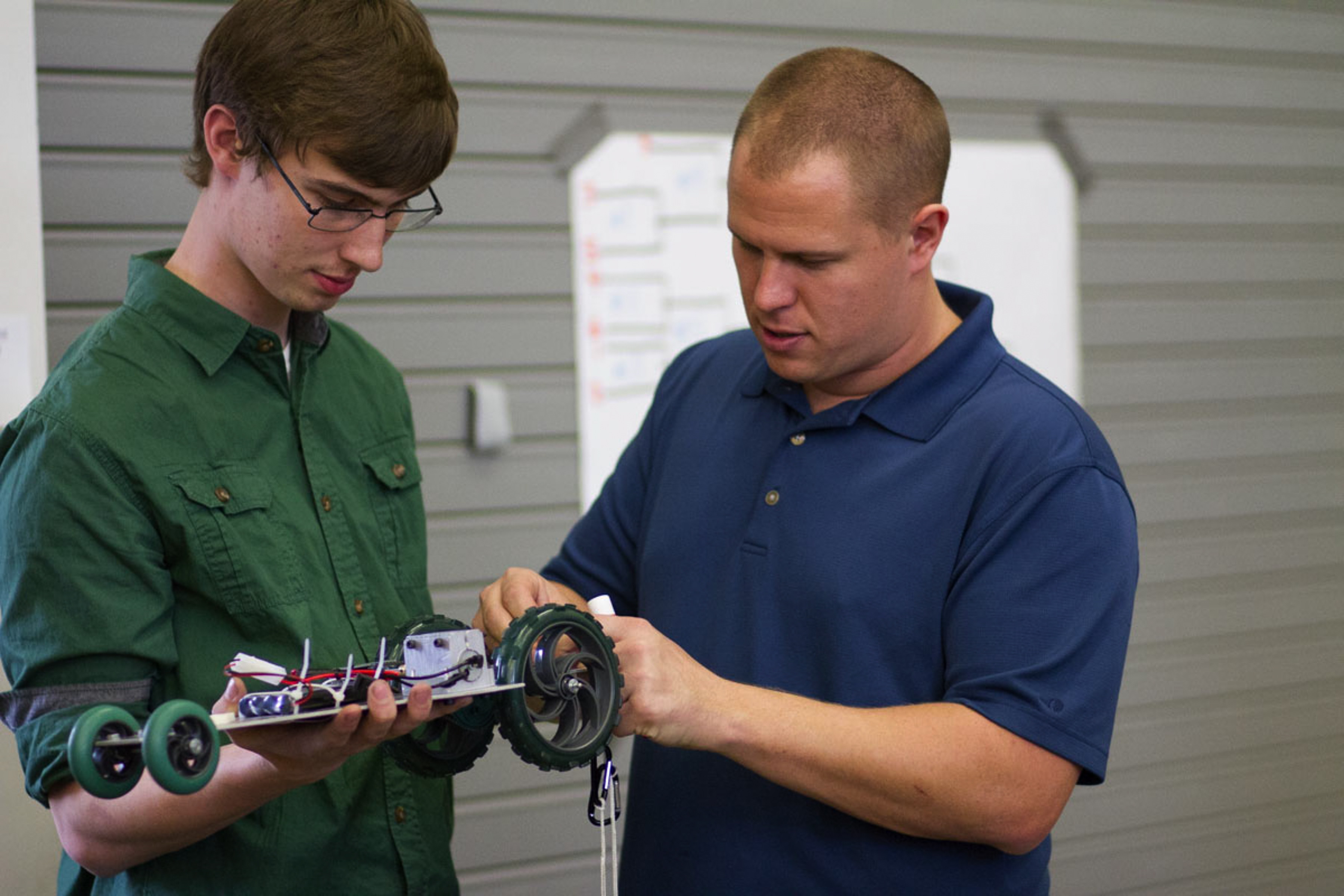
Studying electrical engineering at USI allows you to have a hands-on experience with smaller class sizes. As part of the BSEE program at USI, you will have the opportunity to experience the various topics of circuits, microprocessors, embedded systems, signal processing, power, and control.
Most electrical engineering courses have both lecture and lab components, allowing for a solid mix between fundamental theory and hands-on experience. Furthermore, you’ll have many opportunities to engage in projects both inside and outside of class. Most students have some internship or co-op experience upon completion of the program. Faculty are highly engaged with the students and focused on your success.
Course requirements will load when this section is opened.
To apply to the University of Southern Indiana (USI) for undergraduate enrollment:
Once USI has processed your application, transcript(s) and scores (if needed), a decision will be made by Undergraduate Admissions and you will receive a notification.
Upon acceptance to USI, you'll receive detailed information about next steps, including orientation, registration and housing.
Upon leaving USI with a Bachelor of Science in Electrical Engineering, you’ll be ready to enter the engineering workforce. Graduates are commonly placed in the power systems, automation and control, and defense fields, among others. The overwhelming majority of students pass the Fundamentals of Engineering exam and start the path to becoming a Professional Engineer.
The University of Southern Indiana is committed to making college accessible to those wishing to further their education by providing numerous scholarships, grants, and financial aid options to assist students in managing tuition expenses.
 The Bachelor of Science in Electrical Engineering (BSEE) program is accredited by the Engineering Accreditation Commission of ABET, https://abet.org, under the commission’s General Criteria and Program Criteria for Electrical, Computer, Communications, Telecommunication(s) and Similarly Named Engineering Programs.
Requirements for licensure and certification vary by profession and by state. USI has reviewed the educational requirements for each state and licensing agency to determine if the academic program here at USI meets the educational requirements to be eligible for licensure/certification in each state or not. Please note that some states may have additional requirements for licensure, such as residency requirements, additional non-academic certifications, etc. that USI cannot determine. We encourage you to check with your state's licensing agency for all requirements needed to obtain licensure.