


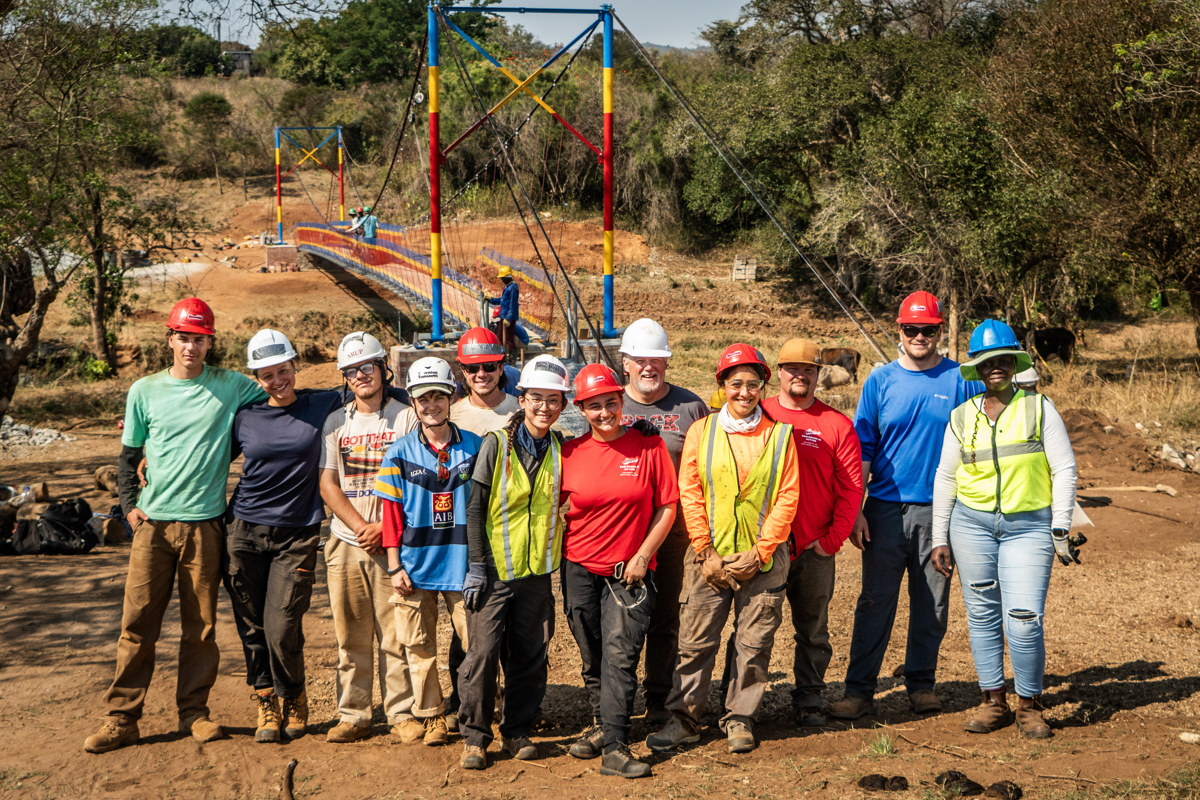
USI students complete first solo-build bridge in Eswatini
Browse a photo gallery from the trip (credit: Tyler Welsh)
This summer, the University of Southern Indiana’s Engineers in Action (EIA) chapter led the design, development and construction of a pedestrian footbridge in Eswatini in Southern Africa, to connect isolated communities to critical services such as shops, schools, clinics, co-ops, churches and more.
This trip marks USI’s first solo-build experience. In recent years, USI has led teams of students from as many as three institutions to complete bridge projects. This year, after being one of the only institutions trained on the suspension bridge technique, USI not only led the design and development, but were the lead educational institution on site for the construction of the bridge. USI also trained two students from McGill University during the build.
"After years of collaborating with other institutions, this year was the first year USI completed a suspension pedestrian bridge, leading in all major roles," said Dr. Susan Ely, USI Assistant Professor of Engineering. "This project demonstrates how USI has grown to be a leader in humanitarian engineering projects, employing the newest building techniques and training other universities for their own development."
The team consisted of seven students as well as Ely and Dr. Keith Pate, Assistant Professor of Engineering.
Jonas Hollis, manufacturing engineering major from Indianapolis, served as Co-Project Manager, overseeing all aspects of the build. This included working with each member of the team to ensure they worked efficiently, communicated well and collaborated with the community and other project stakeholders.
Kelsey Ellis, civil engineering major from Princeton, Indiana, served as Co-Project Manager, sharing the same responsibilities as Hollis.
Sophia Miranda, English major from Terre Haute, Indiana, served as Safety Manager. This role is responsible for maintaining a safe work environment for everyone participating in the bridge build, which included ensuring everyone was wearing appropriate personal protective equipment, ridding the environment of unsafe conditions or tripping hazards and monitoring work as it is completed.
Tristan Coburn, mechanical engineering major from Fort Branch, Indiana, served as Design Manager. This role ensures that everything is built according to the design, draws "as-built" plans that reflect the bridge as completed, measures to ensure all construction is within allowable tolerances and proposes alternatives for situations where the design cannot be executed within tolerances.
Kaleigh Baehl, a mechanical engineering major from Fort Branch, served as Quality Manager. This role included verifying and validating all critical construction points throughout the building process.
Andrew Klem, political science major from Evansville, served as Logistics Manager. This role is responsible for ordering materials in advance, inventory of materials and tracking of materials being used each day.
Nicholas Barnett, psychology and political science major from Newburgh, Indiana, served as Construction Manager. This role includes monitoring the construction schedule and briefing the team and community every morning on what daily tasks need to be accomplished.
"Something that made this bridge build unique was the variety of perspectives on the team," said Barnett. "I do not have an engineering background and neither did some of the other team members, but I think having diverse backgrounds made the experience more enriching for each of us."
In the Fall and Spring Semesters leading up to the trip, the team collaborated closely with EIA and a professional engineer (P.E.) assigned to the project who verified all design calculations were completed by the student team. Students designing and planning the bridge project complete work equivalent to one of their engineering courses, and many utilize their Senior Design course to complete the work necessary for the project. USI also hosts multiple training sessions on key technical skills and basic language skills prior to departure which are required for all students.
USI’s EIA chapter is a part of the national EIA organization which improves the lives of thousands of people every year by building critical infrastructure in their communities including bridges and access to clean water. USI has sent student teams to Eswatini in South Africa in 2025, Eswatini in South Africa in 2024, Eswatini in South Africa in 2023, Bolivia in 2022, West Virginia in 2021 and Eswatini in South Africa in 2019.
The trip was generously funded by the USI Foundation.
Students of all majors are invited to participate in EIA and bridge project events. For more information about EIA, contact Ely at sely@usi.edu. For more information about USI’s accredited Engineering Program, visit USI.edu/engineering.