


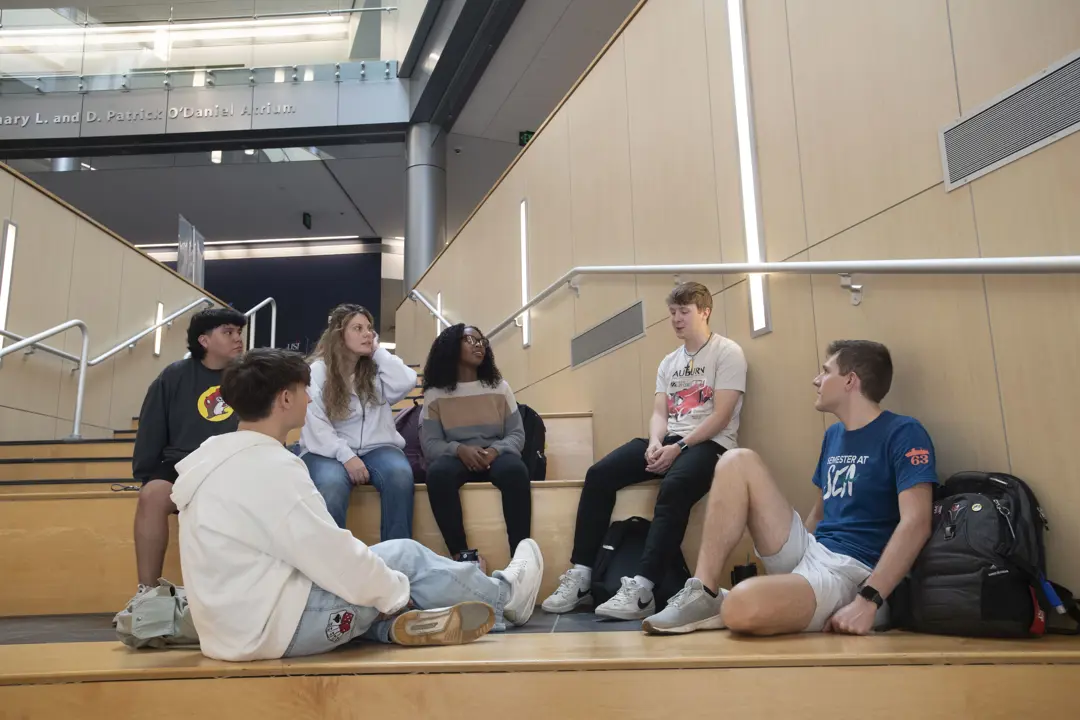
From students earning top finishes in supercomputing conferences, to hands-on learning in state-of-the-art facilities, to interactive classroom learning with AI technology, we prepare our graduates to stay ahead of the curve and thrive in a rapidly evolving business landscape.
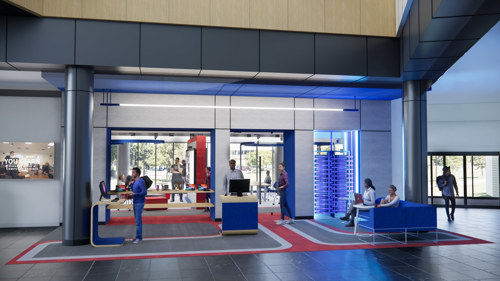
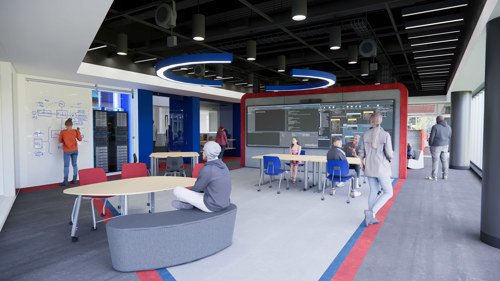
This can be seen in our Center for Applied Business Technologies, coming soon to the Romain College of Business. In this space, our state-of-the-art labs -- the Biometrix Discovery Lab and Textual Analytics and Publishing Lab (TAPLab) -- will be joined by an AI Cafe, a Flex Lab, an Innovative Learning Space and several hubs with technology such as Watson-x.ai and Bloomberg Terminal. By being located in one area, students and faculty will have a space to collaborate, innovate and engage with the technologies constantly changing the way businesses operate and create new value.
The Center will allow the Romain College of Business to offer students access to this technology from the start of their undergraduate academic career to commencement (and beyond!) while serving as a catalyst for transformative change, incorporating cutting-edge themes that resonate with the dynamic nature of the business and technology sectors in southwest Indiana and beyond.
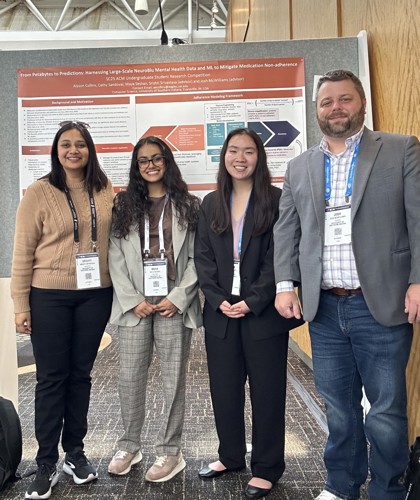 A team of computer science students and faculty from the University of Southern Indiana represented the Romain College of Business at the Association for Computing Machinery Super Computing 25 (ACM SC25) International Supercomputing Conference in St. Louis in November. Their participation highlighted the growing national visibility of USI’s Computer Science Program and the high-caliber research being conducted by students.
USI students Alyson Collins and Maya Seshan achieved significant recognition at the ACM Student Research Competition, where their project was selected as one of the top 10 posters from a pool of nearly 500 submissions submitted by computer science students worldwide. Their research project, An ML Model for Predicting Medication Non-Adherence Using Large-Scale Mental Health Data, stems from USI’s collaborative partnership with Holmusk and its NeuroBlu data platform.
Under the guidance of Dr. Srishti Srivastava, Associate Professor of Computer Science, and Josh McWilliams, Instructor in Computer Information Systems, Collins and Seshan presented their findings to international attendees, receiving an overwhelmingly positive response from researchers, industry leaders and practitioners in the supercomputing community.
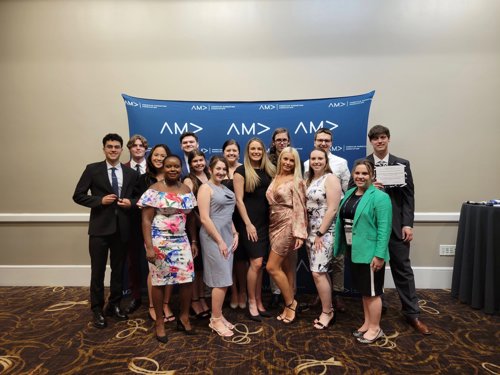
In 2023, a student team of seniors, Courtney Bourne and Jaeden O’Dell-Schultz, from the Romain College of Business placed second in the Undergraduate Research Competition at the AMA International Collegiate Conference in New Orleans, Louisiana.
The conference included over 1,300 students from 360 different chapters of universities across the globe, including teams from institutions such as Arizona State University, University of Florida, University of Kentucky and Penn State University. USI was the only college in the state of Indiana to place in the competition.
Bourne’s and O’Dell-Schultz’s research presentation focused on the application of neuroscientific techniques, such as eye-tracking, to learn about students’ emotional responses and visual attention when viewing different social media accounts. Research that took place by leveraging USI's AI-based neuromarketing tools.
The USI team had to be selected to present after submitting a research abstract. At the conference, they went through two rounds of judging where they had two minutes to present research and three minutes to answer questions. This took place seven times with seven different judges.
“Applying my marketing knowledge to a unique project provided insight into the daily responsibilities of professional marketers. Our team's second place win at an international conference demonstrated the quality of our education and the value of our efforts,” said O’Dell-Schultz. “Overall, this experience was amazing and helped me gain a better understanding of my future profession.”
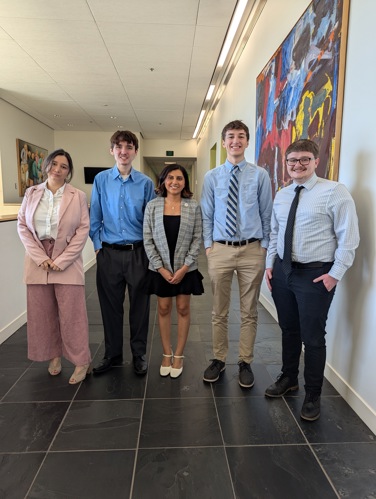 For years, researchers have struggled to access large-scale behavioral health data. Now, undergraduate students in the Romain College of Business are among the first in the country to work with a real-world mental health dataset, thanks to a partnership with Holmusk, a behavioral health data analytics company.
USI's Computer Science Program is using NeuroBlu, a research platform containing over 30 million anonymized patient records spanning 20+ years. This gives students hands-on experience analyzing big data in behavioral health before entering the workforce.
“Even as a PhD student, I didn't have access to such large-scale real-world data, especially anonymized data in health fields because it's difficult to get it. If you're able to get it for undergrad students, that's unique,” said Dr. Srishti Srivastava, Associate Professor of Computer Science. “We’re in a world of data analytics and machine learning and generative AI, and for the students to have access to this kind of data is a very unique experience and a valuable technical skill to have when they walk out with that degree.”
“Some projects that you do in school are all pre-tested with mock data,” said Joshua Dellamuth '25. “But this isn’t fake data, this is real life experience. It helps a lot before you get out into the working world.”
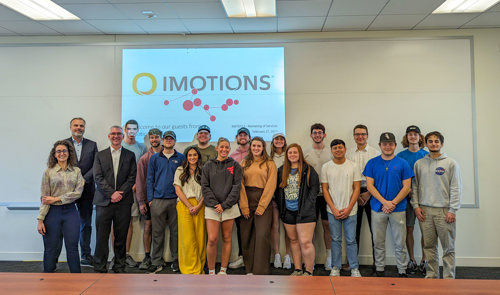 In an era where understanding consumer behavior is more critical than ever, the Romain College of Business is focusing on two learning competencies to ensure students' education includes access to cutting-edge AI tools giving them a competitive edge in the marketplace as well as market-leading skills in neuromarketing and textual analytics.
Learning these skills allows students to meet the College's value proposition created by Dr. Sudesh Mujumdar, Dean of the Romain College of Business: Leveraging technology in unique ways to build market-leading competencies in our students in a personalized, co-created learning environment.
Through iMotions, an IT company specializing in human research software that has been featured in our Biometrix Discovery Lab, RCOB students have access to the company's software called EduLabs. The web-based platform enables students to use iMotion's eye-tracking and facial expression analysis software remotely using any laptop equipped with a webcam. The EduLabs platform is integrated into the Introduction to Marketing course, taken by all Romain College of Business students, typically in their second semester of freshman year. Graduate students will also use the technology in the Marketing Strategies course within the MBA program.
"The knowledge and skills I acquired have been important in my career," said Courtney Bourne '23, marketing. "As a Marketing Insights Analyst for First Financial Bank, I apply these lessons daily to analyze consumer behavior, identify patterns and uncover trends."
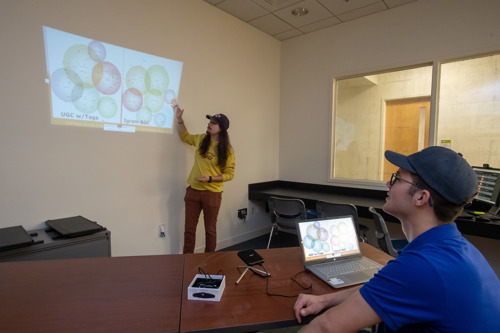 In addition to neuromarketing, each undergraduate business student is introduced to the market-leading skill of textual analytics. Textual analytics is the analysis of any text-based or unstructured data for the purpose of understanding deeper information in those data.
The College created its own AI-data-scraping facility called TAPLab, providing students with an in-house advantage. In the Lab, students use Natural Language Processing to comprehend and comb through large amounts of data. A recent assignment had students scraping the internet for job listings in major regional cities—including Indianapolis and St. Louis—to discover the most common baseline skills required and prepare them for what employers are looking for in job searches.
"[Professors] at USI always try to keep up to date with the current technologies," said Lilly Neeson '25, computer science, former project manager in the TAPLab. "This is an essential part of being in the tech industry."
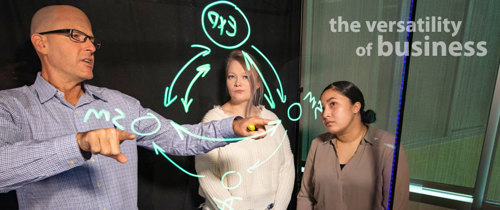 In the fall of 2025, we expanded our nationally recognized Master of Business Administration Program to include a concentration in AI. The Artificial Intelligence concentration develops proficiency in AI-driven business strategies, decision-making processes and AI tools for business innovation and efficiency. The program offers cutting-edge AI skills tailored to today's business landscape, enabling professionals to stay competitive by mastering tools and techniques in high demand.
Just in a short span of time, the program has already received accolades from Poets & Quants as one of the Top MBA Programs in the United States and Europe to offer a concentration in AI and was also ranked 15th by MastersInAI.org for Best Online MBA in Artificial Intelligence.
"Our MBA program stands at the intersection of business and artificial intelligence, empowering professionals to harness AI for strategic transformation and business success,” said Dr. Curt Gilstrap, Professor of Business Communication.
In the Romain College of Business, you will learn AI-related skills and concepts no matter your major. There are a multitude of classes that utilize AI by having students participate in a variety of projects to even hands-on learning in our labs. Here are some examples of AI-focused classes in our college:
Business Communication
Computer Information Systems
Computer Science
Marketing
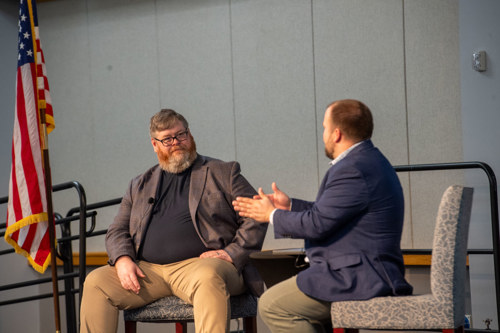 In 2025, we launched our Romain Market Makers Speaker Series which brings to campus innovative leaders and visionaries who have helped to “move the market” by shaping industries, driving growth and redefining the future of business. AI has played a big role in several of these discussions.
Brian Martin, Chief AI Product Owner for a Fortune 500 pharmaceutical company, spoke with students about how he's seen the ebbs and flows of AI over time and how changes in technology has had a profound impact on college students. He said he's grateful that discussions about AI are happening across college campuses worldwide.
“Students need to see AI as a tool. The same way they carry around their laptops, they need to be carrying around the AI capabilities within that laptop,” Martin said. “They need to find a way to make that tool part of what they’re doing every day.”
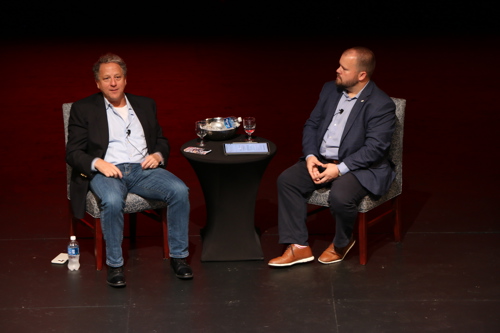
David Siminoff, a noted Silicon Valley entrepreneur and investor, discussed with students how they need to be prepared to work with AI as they enter their respective career fields. He said they should simply consider it another part of their daily education.
"AI is not an optional thing to understand. You don't have to build it. You don't have to know how to code an AI algorithm. But you do have to know how to optimize it,” Siminoff said.
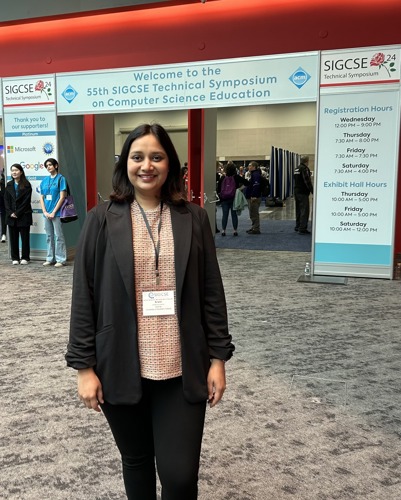 Dr. Srishti Srivastava, Associate Professor of Computer Science, brings nationally recognized expertise in artificial intelligence to the Romain College of Business. Her AI-focused research has been featured in multiple academic publications, and she represented NSF-funded work at the Technical Symposium on Computer Science Education as part of the Center for Parallel and Distributed Computing Curriculum Development and Educational Resources (CDER). Dr. Srivastava is a member of the University's AI Advisory Board and also engages students beyond the classroom, addressing real-world issues such as “navigating the AI divide” through campus conversations with student media.
Dr. Srivastava along with Dr. Mark McKnight, Professor of Accounting, Dr. Cristina Gilstrap, Associate Professor of Business Communication, Dr. Curt Gilstrap, Associate Professor of Business Communication and Dr. Kenneth Shemroske, Professor of Computer Information Systems had research published in the Journal of Applied Business and Economics titled Generative Artificial Intelligence in Applied Business Contexts: A Systematic Review, Lexical Analysis, and Research Framework. This is just one of many examples of faculty research involving AI.
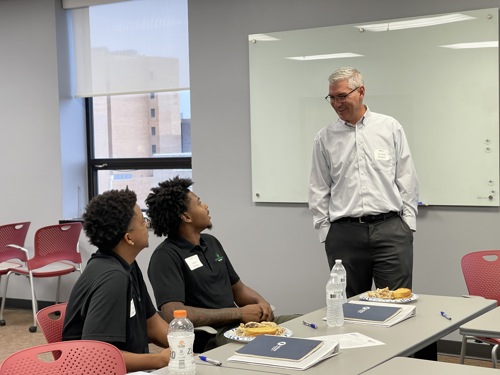 Dr. Chad Milewicz, Associate Professor of Marketing and Chair of the Economics and Marketing Department, was featured on iMotions EduLabs website discussing the impact neuromarketing has had on our RCOB students. The EduLabs software is a web-based platform accessible to any student with a laptop and a webcam and allows them to participate in research and projects with eye-tracking and facial analysis technology without having to be in a lab setting. According to iMotions, the Romain College of Business is one of the first in the world to pilot this high-level technology to all undergraduate business students within the University.
"When they go into interviews with prospective employers, they can talk about real experiences. They'll be able to talk about the application of technology that their peers won't be," Milewicz said. "They'll be able to ask questions and share insights that are much further along. We see this as a really important part of what we offer."
Thinking about studying at USI? Get in touch for more information.
Interested in using the Center or learning more about what we have to offer for our community partners?