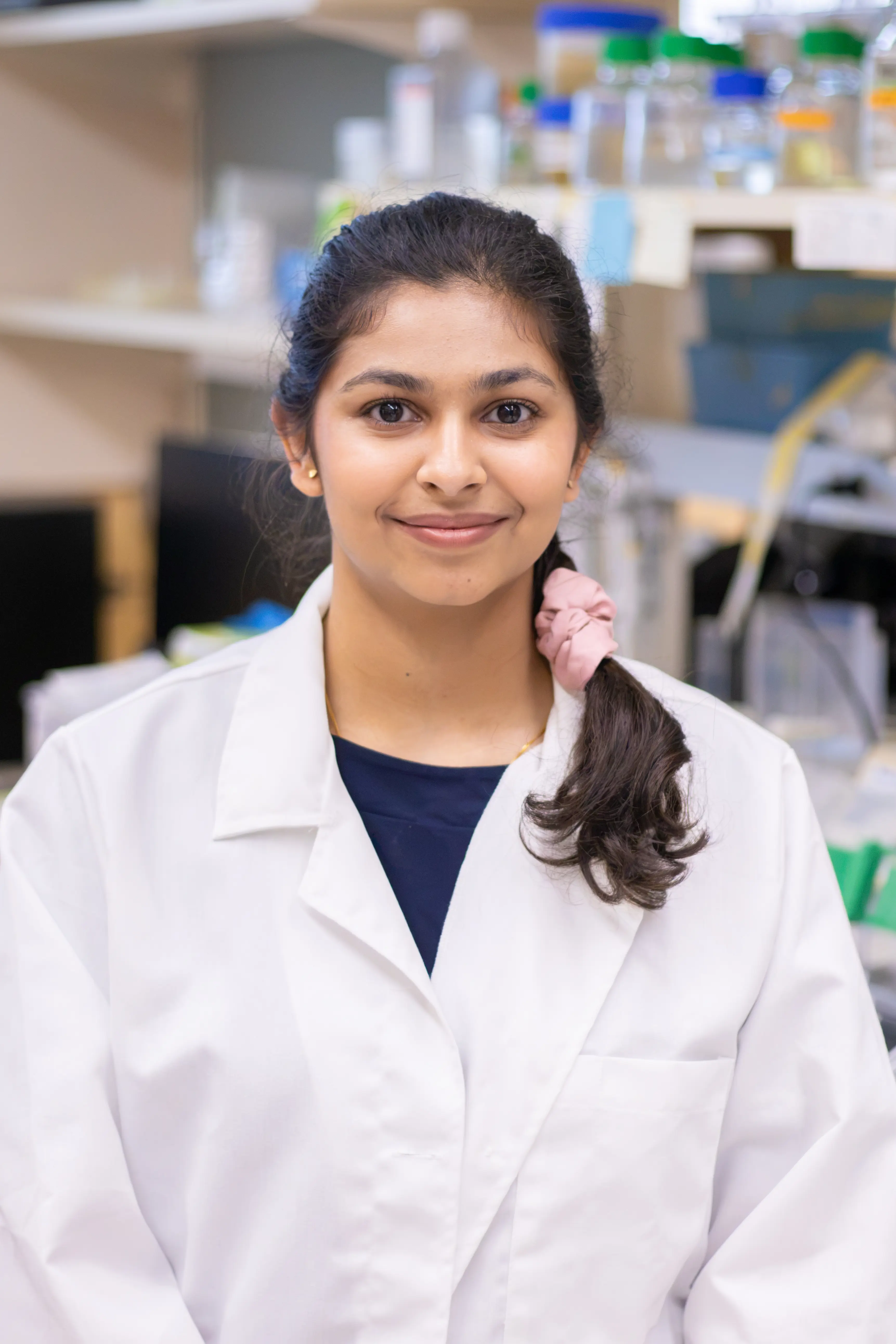
Arya Shah is from Carmel, Indiana, majoring in pre-medicine through the B/MD program, with an expected graduation in May 2028. Over the past two summers, she has conducted research in nanomedicine and targeted therapies, first working on a biosensor for the early detection of pancreatic cancer, then on a targeted therapeutic approach. She hopes to become a physician-scientist.
What drew you to the B/MD program at USI, and what has that pathway looked like so far?
I came from a very large high school, and sometimes I felt like I could lose my identity in the noise of it all. When I was looking at colleges, I wanted an environment where I could grow without feeling like just another student. Honestly, when I first started looking at USI, I had never even heard of Evansville before. But as I learned more, I realized that the close-knit environment USI provides was exactly what I was looking for.
USI is special because of how focused and personal the experience is. The small class sizes make it easy to build lasting connections with faculty and other students, and there are so many opportunities to get involved both on campus and through the Evansville community. I've been able to pursue academics, research, leadership and service while still feeling like I'm part of a tight community that cares about me.
The B/MD program felt like a natural extension of that environment. Beyond the incredible opportunities and benefits of the program, one of the things I value most is the support system. We have dedicated faculty and pre-med advisors in chemistry and biology who guide us through every stage of the process from navigating tough undergraduate coursework and preparing for the MCAT, to eventually applying to medical school. Having that guidance has made the path feel much less overwhelming.
No one in my family is in the medical field, and I didn't know anyone at the time who was, so i initially wondered what navigating this path would look like for me. But though the B/MD program at USI, I've never felt like I had to figure it out alone. So far, the pathway has given me not only a clear direction toward medicine, but also the confidence to explore my interests, challenge myself and grow into the kind of future physician I hope to become.
How did your USI coursework or professors prepare you to walk into a research lab?
To be honest, I was very intimidated by the lab before I started my coursework at USI. I didn't have much laboratory experience in high school so it felt strange to suddenly be spending six to nine hours a week in lab. I was worried I wouldn't be good at it and that I would constantly make mistakes.
Talking with my professors really helped change that mindset. They reminded me that no one is perfect in the lab and that even they have made mistakes throughout their careers. That made me much more comfortable with the idea that making mistakes is actually part of the learning science.
While I still wouldn't say that labs are my favorite part of chemistry and biology, I've gained a lot of confidence in myself over the yeats. I've learned to appreciate the independence that comes with experimenting, troubleshooting when something doesn't work and trying again rather than being afraid of making a mistake.
My coursework has also given me a strong foundation that I carry with me into research. I've become familiar with laboratory equipment and techniques, but more importantly, I understand the chemistry and biology behind why those techniques work. That background helps me walk into a research lab with a better understanding of what I'm doing rather than simply following a protocol. Whether I'm using a piece of equipment, interpreting an unexpected result or troubleshooting an experiment, I can connect what I learned in my classes to what is happening at the bench.
I think that combination of hands-on experience, scientific background and the confidence to make mistakes and learn from them has prepared me to be much more comfortable walking into a research lab today.
How did this summer experience compare to your first summer research project? What carried over? What felt totally new?
My first summer research experience involved working on a project focused on developing a highly specialized biosensor for the early detection of pancreatic cancer. This summer, my research was also in the field of nanomedicine and targeted therapies, but they actual project was very different. Instead of developing a diagnostic tool, I was working on designing a targeted therapeutic approach that incorporated concepts I had worked with before, such as aptamers, but in a completely different context.
Even though the projects were very different, a lot of the skills I developed during my first research experience carried over. I was already familiar with concepts like aptamer-based targeting and instruments and techniques such as UV-Vis spectroscopy, microscopy and plate readers. I also became much more comfortable reading and deciphering scientific literature, using Excel to organize and analyze data, and communicating research findings through a convincing scientific poster.
Those skills were especially useful this summer because I wasn't starting from scratch. I knew how to approach scientific papers, identify information that was actually relevant to my project, organize my results and think about how to present them in a way that tells a clear scientific story.
What felt totally new was applying those skills to different scientific questions and learning techniques specific to a new research system. I think that was one of the most valuable parts of this experience. It taught me that research experience isn't necessarily about knowing exactly what to do when you walk into a new lab. It's about having a foundation that allows you to learn, adapt, troubleshoot and contribute when you encounter something you've never done before.
Looking back, how has your understanding of "what research is" evolved between summer one and summer two?
When I first started research, I thought it was something I could wrap up in a week or two. I quickly learned that it's much more of a process. There's literature to review, identifying a question, learning techniques and then weeks of running experiments. Sometimes you get results you didn't expect, which sends you down another rabbit hole of reading, troubleshooting and trying again.
I've learned that research isn't about getting a quick answer. It's about being willing to adapt, ask new questions and follow where the results take you.
What is a moment from this summer that you're proud of, even a small one?
Doing a Western Blot on my own! I did many blots, but it was fun the first time I was able to successfully do it on my own.
You've said you want to be a physician-scientist. What does that combination mean to you, and how did this experience bring you closer to your goal?
To me, being a physician-scientist means combining patient care with research to address problems that I see in medicine. I could be involved in clinical trials for new drugs or therapeutic devices while also continuing wet-lab research. This experience has been an important starting point because it has given me research experience and connected me with fields I'm interested in, especially molecular and cancer biology. Ultimately, I want to use what I learn from patients to help guide the research questions I pursue.
How do you think this research experience will strengthen your medical school application and interviews?
I think this research experience gives me more clarity on who I am as an individual, and what I am passionate about, what skills I have that can also be applied in med school. and makes for a topic of discussion on why I believe that research is integral to a physician's practice, and how I am to do so.
What would you tell an incoming USI student who is interested in pre-medicine?
I would tell them to take advantage of pre-medical advising from the expert faculty in their field, find research opportunities at USI and join student organizations, so they can use those as a starting point to discover what speaks to them most.
How has USI (faculty, advisors, classes, community) supported you in earning and pursuing opportunities like this?
USI has really pushed me to become a better student by constantly putting opportunities in front of me. I really appreciate how tailored everything is especially as a B/MD student. My classes are planned around medical school prerequisites while also giving me opportunities to take courses like genetics that strengthen my background. The plans and guidance they provide make the process feel much more manageable. They also organize events where medical school advisors, doctors, and current medical students come to speak with us, which gives us perspectives and advice that are really valuable. Overall, I've always felt like USI has a plan for me and the support to help me follow it.
What's next for you?
What's next for me is continuing to build on the research I'm doing at USI in the inorganic chemistry lab with Dr. Jacob Lutter, Assistant Professor of Chemistry. I'm hoping to make meaningful progress on the project and eventually develop a poster that I can present at the ACS National Conference in March.
Outside of research, I'm also preparing to take the MCAT this year and plan to continue building my clinical and leadership experiences. All of these experiences are helping me become more prepared for the next step, which is applying to medical school next summer.