


Reading Frederick Douglass
by Joy Priest
Passing down blood
& memory in the blood. Current
pumped through vigorous
as saltwater. What lives inside? Swimming
toward the organ
that sings failure. Ethanol pulling water
from the blood, quieting the sea
inside our arteries. What else was there to do
but release a stream in the field
while pulling clouds? Squeezing sugar
from stalk? Merry our feet to
conceal exhaustion: —Masquerade
dance of Black provenance. You teach me: —O One
who came before in my blood: —
that excess binds, “keeping down the spirit
of insurrection...”
At my grandmother’s funeral
my uncle says I didn’t know you
to have a problem. We’re the same
I say ever last one of us
drink hard like a slave on holiday.
“We felt...that we had
almost as well be slaves to man
as to rum...”
My kin chose rum.
Corn liquor.
Bourbon.
Wine. Gin.
Make tradition from this we were given.
This poem came about because I was re-reading the Narrative of the Life of Frederick Douglass. I was re-reading the Narrative of the Life of Frederick Douglass because I had been asked, by the Frederick Douglass Honor Society in Talbot County, Maryland, to write a poem for Frederick Douglass Day. At the time, I was working on the title series of my new project, the constraints of which were that each poem in the series need have some sort of ecological element and address a classical Black music tradition. I thought I remembered Douglass writing about the Spirituals, which he and his fellow captives sang in the woods. That was enough for me for that poem.
What I didn’t remember about the Narrative was that he addressed alcoholism in the slave community. It was 2022 and I was about 18 months sober. This struck me immediately with the urgency of a poem. I had been thinking about alcoholism as a family disease and what that looked like in families of color, specifically. Thankfully, Jessica Hoppe has written a wonderful memoir about this since then called First in the Family, but at the time I just had the instinct and not the articulation, which for me is always the occasion for a poem. As Lorde writes in “Poetry is Not a Luxury,” “...it is through poetry that we give name to those ideas which are—until the poem—nameless and formless, about to be birthed, but already felt.”
What did it mean to not be the one person in my family with the problem? To not be the single destructive path burning through the well-adjusted and regulated lives of everyone else? For in my family, we all drank together, and from an early age. It wasn’t an aberration, it was a feature of the everyday, a celebration in the face of abject living. It was normal. It wasn’t until I left home that it became apparent that the way I drank was destructive. At the end of my first year of sobriety, my youngest first cousin—named after my grandfather who I recently learned started recovery in his 40s—drank two fifths of Dusse, most of it on IG Live while driving, and crashed into a guardrail ejecting himself from the vehicle and dying on impact.
The following summer I read these words of Douglass, quoted in the poem: “It was deemed a disgrace not to get drunk at Christmas...From what I know of the effect of these holidays upon the slave, I believe them to be among the most effective means in the hands of the slaveholder in keeping down the spirit of insurrection...many of us were led to think that there was little to choose between liberty and slavery. We felt, and very properly too, that we had almost as well be slaves to man as to rum.” This poem constellates my instinct with Douglass’s articulation.
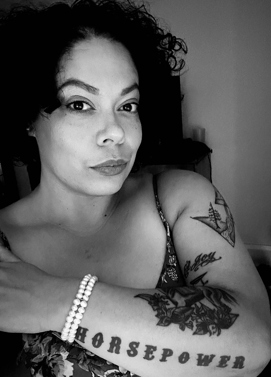 Joy Priest is the author of Horsepower, winner of the Donald Hall Prize for Poetry, and the editor of Once a City Said: A Louisville Poets Anthology. She is a recipient of a National Endowment for the Arts fellowship, a Fine Arts Work Center fellowship, and the Stanley Kunitz Memorial Prize from the The American Poetry Review. Her work has appeared or is forthcoming in Boston Review, The New Republic, Sewanee Review, and Transition Magazine. Priest currently teaches creative writing at the University of Pittsburgh and serves as Curator of Community Programs & Practice at the Center for African American Poetry & Poetics.