


The Link
by Rebecca Foust
You could not have pure love or pure lust nowadays. No emotion was pure, because everything was
mixed up with fear and hatred.
–1984
Wow, what a great Two-Minute Hate, & the best part was the end
where we all chanted, I love Big Brother,
but—how can you say to me now, I love you & mean it, & how can I,
hearing, believe it? How can I share your bed,
fearing you might betray me? Or you share mine? The language
of love is linked to the language of everything.
Beneath words lie feelings that do not lie. A child’s heart is true,
but when taught deceit, the brain learns bitterness
& the mouth how to weave curtains of guile no one can avoid.
Love gets dragged into them, merely baffled at first,
then, like a whale in a driftnet, sinks till it can no longer fathom itself,
or its own depth. The whale will drown.
O Love, let us stay here in our secret room, where there are no secrets
between us, saying the words to each other
till we make them true. Look, it’s midnight. The world is everywhere
webbed with driftnets & what’s caught in them,
muted & tragic & huge, but we’re alive, Love, & here—& we have
exactly one hour.
“The Link” will appear in the second edition of my new chapbook, YOU ARE LEAVING THE AMERICAN SECTOR: Love Poems, which opens with two quotes from George Orwell:
-“To the future or to the past, to a time when truth exists and what is done cannot be undone: from the age of Big Brother, from the age of doublethink—greetings!”
-“We are living in a world in which nobody is free, in which hardly anybody is secure, in which it is almost impossible to be honest and to remain alive.”
My book borrows Orwell’s love-story lens, Julia’s and Winston’s, to examine private life under authoritarian rule and how debasement of truth in official language can affect the way people communicate in their ordinary lives. As in 1984, love becomes an act of rebellion in my poems, and a way to preserve privacy, personal identity, and even reality in the dystopian political landscape that defines our country now.
While I was rushing to press before the 2024 presidential election, I did not have time to finish and include “The Link” in my book’s first edition, but I’m very happy to have it appearing here in Southern Indiana Review and in a second edition of YALTAS forthcoming from Blue Light Press. The poem recognizes an important connection between the language our leaders are using now—what Orwell calls “doublespeak”—and the language of everyday life, suggesting that corruption of any language corrupts all language, and you cannot hear and use doublespeak without its infecting your most intimate communications, and love itself. As Orwell says in says in “Politics and the English Language,” “[I]f thought corrupts language, language can also corrupt thought.”
The whale metaphor came in because I’d been reading about the shocking incidence of whales accidently caught and killed in drift nets in US waters, a consequence of the current administration’s refusal to sign a UN Resolution banning the use of such nets. The image of these massive, benign creatures enmeshed and foundering in invisible underwater curtains, it occurred to me, might describe the sequence of what happens when authentic love encounters subterfuge in language: bafflement, entanglement, sinking, and suffocation. A couplet I ended up cutting from the poem read: “If love survives, it will learn the tangled tonnage of doubt & how / to dwell in a place where any feeling feels false.”
My poem imagines current-day versions of Julia and Winston meeting early on at one of Big Brother’s daily “Two Minutes Hate” rally broadcasts (think any number of right-wing news outlets), and later anywhere they could—in the street, in the hedgerows outside of London, in a secret room that in 1984 was located in the rundown “Prole” District. Another poem in the book, “Last Night in the Room above the Junk Shop” finds those lovers again, just before they are seized by the State. In “The Link,” though, the lovers’ passion is still new, and their freedom and entire future exists only in and of the next hour.
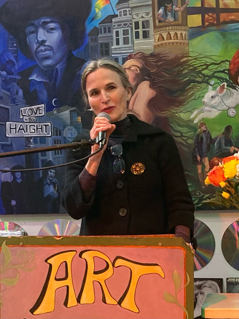 Rebecca Foust’s new chapbook inspired by George Orwell’s 1984, You Are Leaving the American Sector: Love Poems, was just released from Backbone Press. New poems are in The Common, The Hudson Review, POETRY, Ploughshares, and The Southern Review. Foust works as a senior fiction editor for Narrative.