


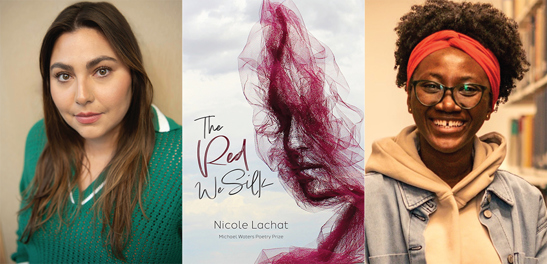
The Red We Silk is a captivating debut poetry collection that invites us into an intimate and complex familial landscape, one we find ourselves thinking about long after we’ve read these poems. With perceptiveness and depth, Nicole Lachat offers a rich and imaginative account of migration, generational histories, and all that is lost and inherited in the crossing of borders. The writing is stripped of any kind of flowery distractions as Lachat explores love and grief, sacrifice and resilience, movement and the preservation of collective memory in powerful and evocative ways. One walks away from this collection pondering the striking portraits of family members and the urgent call to hope and joy, even in the face of loss and despair.
Tryphena Yeboah: This beautiful collection is dedicated to your family, and some of the most moving poems are the ones that capture portraits of relatives, inviting us into intimate moments of their lives. What are your earliest memories of writing about family? Did you have the sense that your poems would explore and carry generational stories?
Nicole Lachat: I was raised in a close-knit nuclear family. Both my parents immigrated to Canada alone; my mother from Peru and my father from Switzerland. The rest of my family remained abroad. Eventually a cousin settled nearby, but for the most part, it was just us. It produced a longing in me for my ancestral homelands, for nearness with my family. I think I started writing about my family as a little girl, in my spiral notebooks, although I wasn’t really aware of it. Even now, so much of my writing is an attempt at digging at this question of identity, of forging out a site of belonging.
I am intrigued by cycles, by continuation. So while the collection also explores my own departures and experiences, it’s important for me to trace those in the larger familial context, to honor the trajectories and labors of those who formed me.
TY: I am trying to imagine you sitting on a couch asking your mother questions about the past or listening to your grandmother tell you about her childhood. Unintentional research all around you. Is that how it was? What are some discoveries you made in this process?
NL: In some ways, it’s been a lifelong process of collecting my bits of thread from different family members. In fact, I was well into adulthood before my mother finally shared some of the real versions of things she’d experienced. Even as my abuelita shared many things with me, she was the queen of redirection. I think sorrow does this. Shame too. But as an adult, I can appreciate the desire for a rewrite. How there are always two versions of a thing: the one lived, and the one we can live with.
TY: It seems important to you to acknowledge the burdens those before you carried, to map out the different ways their past and sacrifices—while unfamiliar to you—continue to remain tied to you in significant ways. I would love to hear more about this tug between not knowing what it was like for them and the gesture towards reimagining their history. And perhaps you can also speak on the lingering sense of shame, this need to be forgiven for having a different life than theirs?
NL: When there is silence in a family, or when we are simply missing certain key pieces, all we can do is fill it with the imagination. I think it’s a fairly human practice. But in that process, especially as a writer, as someone who has been entrusted with the lives of those I love, what matters to me is that my point of view is one of empathy and that in my retelling I also offer some beauty. Beauty is a reprieve, especially if we must live twice. Poetry, as a crafted thing, not only facilitates that, but in some ways requires it.
Regarding the latter half of your question, I wouldn’t say shame is the driving force as much as a profound sense of gratitude. But that gratitude is also embroiled with a level of sorrow for the price others have paid for my privilege. And when you grow up with that awareness, there is often this desire for validation that comes along with it, a desire to know you’re making the right choices, you’re making them proud.
TY: What can you tell me about the title?
NL: I kept asking myself what it was I was trying to do with these poems, what it is we do when we share our stories with one another, our ache, and what poetry as a medium can specifically offer that exchange. I was also thinking of bloodline, of inheritance, these things I carry: my sorrows and theirs, my loves and theirs. These threads I’m trying to weave into something good, into something beautiful, maybe even useful. I hope The Red We Silk conveys that—the desire for transformation.
TY: I love your consideration of the body in the collection: how it carries territories and gathers wars, how it works to hide and disguise, how it becomes this locus of grief, memory, testimony, and history. What was important to you in thinking and writing about the ways the body inhabits all that it lives through?
NL: Thank you for that observation. The body is, of course, the container of our experience. It records us, stores up even what the mind has managed, sometimes in mercy, to forget. And yet, it is also the fragile thing we often dismiss, or fail to hold in gentleness. The body, even simply as an image, teaches us something about the person within it. We are always giving ourselves away—our posture, our sudden movements, our gait. I think that’s interesting. So, this gesture of pointing at what the body may be hiding, or keeping, is, I think, important in our attempt at understanding one another.
TY: In “World News from America,” you write about the sense of normalcy and detachment that marks our life when other parts of the world are crumbling down. It immediately brought to mind Ilya Kaminsky’s poem, “We lived happily during the war.” Does the act of witnessing come easy to you, or do you have to make a conscious choice to look?
NL: Ilya’s poem is absolutely striking. Thank you for bringing it to mind. Witnessing is becoming, I think, both increasingly easier and harder to do. What I mean by that is we have so much access to information, to the live coverage of the continuous happenings in the world, that one has to be rather resolute in order to not look. And yet, we’re tired, aren’t we…The never-ending rolodex of sorrows can feel all consuming. It is a tight wire to walk, but I try not to give up on it. The greater risk is allowing that grief to make us wash our hands of it entirely, of saying, I am not my brother’s keeper. But we are, we must be. You don’t need to go far to witness, after all. What’s happening down your block, in your neighbor’s yard? Check in on your people.
TY: This also makes me think about how the collection makes room for both grief and joy. We get as much loss and despair as we get beauty, love, and hope in the poems. Would you like to speak about the impulse to move between these contradictions?
NL: This was something incredibly important for me in putting this collection together. Some earlier versions of the manuscript had more poems about trauma included, which I eventually decided against. It came down to a question along the lines of ‘What do I want to give life to?’ I want to be able to address the complexities of experience, to acknowledge histories of hardship and grief but not make a home out of them, not to weigh the scale in their favor. After all, here we are. Even as I write this, my mother is singing in another room.
TY: I love these lines in “New Year’s” and their invitation to patience, endurance, and growth:
I wish you growth, which is to say
I hope you become more tree
every day. It’s easier to become fire.
Write down your dreams as they come
Certain births take longer.
In what ways have you changed as a writer and in what ways have you stayed the same?
NL: Thank you, Try. For the most part, the poems I carry forward are often poems that came out in a single sitting. Of course, there is always tweaking that happens, especially in terms of diction or lineation. That being said, I’m trying to be better about not abandoning the poems that are slow in forming. I keep files with fragments in them. So, when I advise patience, I do so as an encouragement to myself.
I’ve certainly changed as a writer since first coming to poetry. But I have always had a penchant for sentimentality in my work, one which has, at times, accused me of being saccharine. I’m trying to be better at catching this early in the process, though I refuse to give it up entirely. And of course, workshops and the brilliant gaze of better writers than myself have taught me to slice a poem up more readily when need be.
TY: You reference Derek Walcott, Joy Harjo, Adam Zagajewski and other poets in the collection. So, how about we end on this note of poets and poems that have stayed with you over the years:
A poet you’ll read anything by: There are so many! Let me say, Li Young Lee and Tracy K. Smith.
A poet that inspires you: Nathalie Handal
A poem you know by heart (or wish to know by heart): I have “The Fall of Rome” by W.H. Auden memorized, but I really ought to memorize more poems.
Two nightstand poetry collections: Wislawa Szymborska’s View With a Grain of Sand, and Mary Oliver’s New and Selected Poems, volume one.
A collection you’ll read again and again: Walcott’s White Egrets
A poem for the new year: “Try to Praise the Mutilated World” by Adam Zagajewski
A poem for a hard season: “Wait” by Galway Kinnell
A poet you’ve recently discovered: Arah Ko—I heard her read some months ago and immediately swooned.
Two poems we should read after reading this interview: “Purple” by Kwame Dawes and “To The Fig Tree on 9th and Christian” by Ross Gay.
Tryphena Yeboah is the author of A Mouthful of Home (Akashic Press, 2020). She teaches English and creative writing at Tennessee Wesleyan University.