


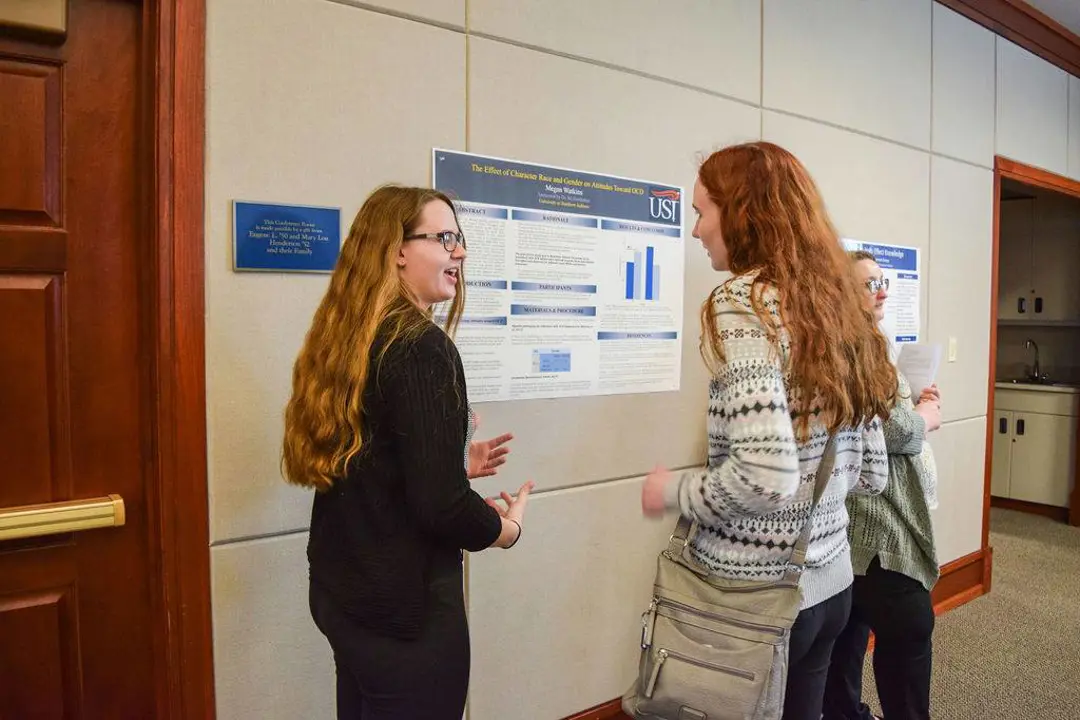
Student research gives psychology majors the opportunity to explore questions about human behavior through the scientific method. Whether you're completing a class project or collaborating with a faculty mentor, students learn how to develop research questions, design studies, collect and analyze data, interpret findings, and communicate results while contributing to the advancement of psychological knowledge.
Several psychology courses provide opportunities to design, conduct, and communicate research.
In PSY 303 - Research Methods and Statistics I, students work in small groups to develop a research question, find relevant background literature, and design a research study on the topic of their choice. In PSY 353 - Research Methods and Statistics II, students continue working with their groups to obtain ethics approval, collect participant data, analyze responses, and present their findings. In PSY 325 - Test and Measures, students create a measure that is validated with a student sample.
Students seeking a more individualized research experience may work directly with a faculty mentor through PSY 499. Students enroll for 1-3 credit hours, which corresponds to 3-9 hours of research activities per week. Through PSY 499, students can join an existing faculty research project or collaborate with a faculty mentor to develop and conduct their own independent study. Research responsibilities vary by project but may include reviewing scientific literature, designing studies, recruiting participants, collecting and analyzing data, preparing conference presentations, and contributing to manuscripts.
For students who want research experience without enrolling for credit, some faculty members also welcome volunteers to assist in their research labs.
Research does not end when a project is completed. Psychology students have opportunities to share their findings through conference presentations and research publications. Disseminating research allows students to contribute to scientific knowledge, develop professional communication skills, and gain valuable experience engaging with audiences beyond the classroom.
Working with a faculty mentor, students may present their work through poster presentations, paper presentations, panel discussions, and other scholarly formats. These experiences help students build confidence, strengthen graduate school and job applications, and expand their professional networks.
Over 100 past students have presented at different conferences, including:
USI Psi Chi Undergraduate Psychology Research Conference (UPRC)
USI Honors Symposium
USI College of Liberal Arts Interdisciplinary Colloquim
USI Endeavor Undergraduate Research and Creative Works Symposium
Midwestern Psychological Association's (MPA) annual meeting
Mid-America Undergraduate Psychology Research Conference (MAUPRC)
Indiana Academy of the Social Sciences' (IASS) annual meeting
Society for Personality and Social Psychology's (SPSP) annual convention
American Psychological Association's (APA) annual convention
Association for Psychological Science's (APS) annual convention
Students may also have opportunities to publish their research. Publication allows students to contribute to the scientific literature and demonstrate their ability to conduct and communicate high-quality research. Faculty mentors work closely with students throughout the writing, revision, and submission process.
While publication is not a requirement of undergraduate research, students who pursue this opportunity gain valuable experience in scientific writing, responding to feedback, and participating in the scholarly publication process. Publishing research can be a particularly strong asset for students considering graduate school or research-oriented careers.
Past students have submitted their work to the undergraduate-friendly journals, including:
Journal of Psychological Inquiry
Modern Psychological Studies
Psi Chi Journal of Psychological Research
USI Psi Chi's Journal of Undergraduate Psychology Research (JUPR)
Midwest Social Sciences Journal
USI offers several funding opportunities to help students conduct research and share their work with professional audiences. Available funding sources include:
Endeavor Research Grants to support undergraduate research projects and student-faculty collaborations.
Endeavor Presentation Awards to help cover expenses associated with presenting research at professional conferences.
Student Affairs Travel Grants to support travel and participation in conferences and other professional development opportunities.
USI Foundation Funding and other university-supported resources that may assist with research expenses, conference travel, and scholarly activities.
Students interested in pursuing research are encouraged to discuss funding opportunities with their faculty mentor early in the process. These resources can help make research and conference participation more accessible, allowing students to engage with the broader psychological community, share their findings, and expand their professional networks.
Research experiences help students develop the skills and experiences that employers and graduate programs value most. Through the research process, students strengthen several of the NACE Career Readiness Competencies, including:
Critical Thinking by analyzing data, evaluating evidence, and solving research problems.
Communication by presenting findings, discussing ideas, and writing about research.
Teamwork by collaborating with faculty mentors and fellow researchers.
Technology by using statistical software, research databases, and data management tools.
Leadership by taking ownership of projects and contributing to team goals.
Professionalism by meeting deadlines, managing responsibilities, and conducting ethical research.
Career & Self-Development by exploring interests, setting goals, and reflecting on personal growth.
Research experience can also strengthen applications for graduate programs in psychology, social work, occupational therapy, medical school, and other related fields. Working closely with faculty provides opportunities to receive personalized mentoring, learn about career pathways, and develop meaningful professional relationships. These relationships often lead to stronger and more detailed letters of recommendation for graduate school, internships, scholarships, and employment opportunities.
Even if you do not plan to attend graduate school, research experience demonstrates initiative, problem-solving ability, and analytical thinking, qualities that are valued across a wide range of professions.
The best way to get started is by exploring the faculty research interests within the Psychology Department. Visit our Research Labs page to learn about current research projects and identify faculty members whose interests align with your own.
Once you find a faculty member whose work interests you:
Read about their research areas and ongoing projects.
Consider how your interests connect to their work.
Reach out to introduce yourself and express your interest in getting involved.
Be prepared to discuss relevant coursework, experiences, and goals.
Faculty research opportunities vary each semester, so students are encouraged to explore options early and connect with potential mentors the semester before you want to begin getting involved.
Students can get involved in research at any point in their academic career, though many begin after completing PSY 303, when they have been introduced to research methods and statistics. Students considering graduate school are encouraged to start early and work with a faculty mentor across multiple semesters to build research skills, gain meaningful experience, and develop strong letters of recommendation.
No. Many students begin their first research experience through coursework such as PSY 303 or by joining a faculty project with no prior research experience. Faculty mentors will help you learn the skills needed to contribute to a research project.
That's completely okay. Many students discover their research interests by taking psychology courses, talking with faculty, attending research presentations, or getting involved in a project. Research is a great way to explore different areas of psychology while learning what excites you most.
The best place to start is the department's research labs research webpage. Review faculty research interests and reach out to faculty members whose work aligns with your interests!
Research experiences through PSY 499 are compensated through academic credit rather than hourly pay. Students may enroll for 1-3 credit hours, which typically corresponds to approximately 3-9 hours of research activities per week. These credits can count toward the psychology major, psychology minor, or general electives.
Time commitments vary depending on the type of research experience. Students enrolled in PSY 499 typically spend approximately 3-9 hours per week on research activities, depending on the number of credits earned.
While research is especially valuable for students considering graduate education, it also helps students develop transferable skills in critical thinking, communication, teamwork, technology, and problem-solving that are valued across many careers.
Absolutely! Many students participate in research across multiple semesters, which allows them to progress from assisting with a project to designing their own independent study. Some students also work with multiple different faculty members. Each experience offers new opportunities for learning and professional growth.
Yes. Students may be eligible for funding through programs such as Endeavor Research Grants, Endeavor Presentation Awards, Student Affairs Travel Grants, and other university-supported funding sources. Faculty mentors can help students identify and apply for relevant opportunities.