


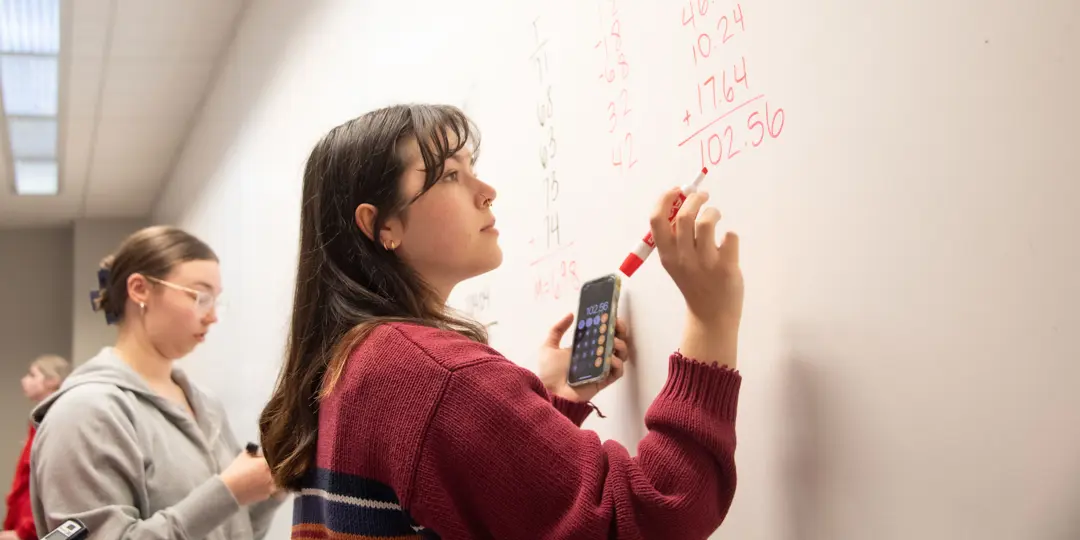
Student teaching gives psychology majors the opportunity to apply their knowledge beyond the classroom by supporting teaching and learning within the department. Working alongside faculty mentors, student teachers take an active role in the educational experience of their peers, helping to create engaging and supportive learning environments.
We offer 3 types of student teaching experiences in the Psychology Department.
Teaching Assistants (TAs) play an important role in supporting students enrolled in large sections of Introduction to Psychology (PSY 201). In this paid position, TAs work approximately five hours per week helping to foster a welcoming and engaging classroom environment. By connecting with students before and after class, TAs help reduce barriers to asking questions, seeking support, and becoming involved in the course. TAs also contribute to the broader campus community by creating promotional materials for campus events. Depending on the needs of the course and their interests, TAs may have opportunities to lead review sessions, develop study resources, and assist with other initiatives that enhance student learning and engagement.
To qualify to be a TA, you must:
Have previously completed PSY 201 at USI or another institution (including high school credit); ideally at USI with the same instructor - but not required
Received an A or B in PSY 201
Have an overall GPA of 3.0 or above
Supplemental Instructors (SIs) support student success in Introduction to Psychology (PSY 201) by helping students engage with course material in a collaborative, supportive learning environment. In this paid position, SIs work up to 10 hours per week serving as a friendly and approachable resource for their peers by connecting with students before and after class to answer questions, share resources, and reduce barriers to seeking academic support. SIs also facilitate two study sessions each week, guiding students through course concepts, study strategies, and collaborative learning activities. Drawing on their own success in the course, SI Leaders help students strengthen their understanding of psychology while fostering a welcoming, non-judgmental environment where all students can thrive.
To qualify to be an SI, you must:
Have previously completed PSY 201 at USI or another institution (including high school credit); ideally at USI with the same instructor - but not required
Received an A or B in PSY 201
Have an overall GPA of 3.0 or above
For more information on SIs, please see USI's SI Study Groups page.
Peer Mentors (PMs) support students enrolled in Research Methods and Statistics I (PSY 303). PMs earn 3 credit hours through PSY 499, which may count toward the psychology major, minor, or general elective hours, and devote approximately nine hours per week to the role. By connecting with students before and after class, PMs help reduce barriers to asking questions and seeking support in a class students find challenging. PMs also leading a weekly study session to reinforce course concepts, build confidence, and encourage academic success.
To qualify to be a PM, you must:
Have previously completed PSY 303 at USI, ideally with the same instructor - but not required
Received an A or B in PSY 303
Have an overall GPA of 3.0 or above
Student teaching is more than a way to support your fellow students. It is an opportunity to develop the career-ready skills that employers and graduate programs value most. Through mentoring, leading study sessions, collaborating with faculty, and supporting student learning, you'll gain hands-on experience applying the competencies identified by the National Association of Colleges and Employers (NACE).
As a student teacher, you'll develop:
Career & Self-Development by setting professional goals, seeking feedback, and reflecting on your growth.
Communication by explaining concepts, answering questions, and connecting with students from diverse backgrounds.
Critical Thinking by helping students navigate challenges and identifying effective strategies for learning.
Equity & Inclusion by fostering welcoming and supportive learning spaces where all students feel comfortable seeking help.
Leadership by guiding peers, facilitating learning, and helping create a positive classroom environment.
Professionalism by demonstrating responsibility, reliability, and accountability in your role.
Teamwork by partnering with faculty and fellow student leaders to support student success.
Technology by creating digital learning materials and leveraging educational tool to support student learning.
Whether you're considering graduate school or entering the workforce after graduation, student teaching provides meaningful experiences that help you grow as a scholar, leader, and professional while making a lasting impact on your peers.
Applications for student teaching positions are emailed to all psychology majors and minors each semester prior to priority registration. After applications are reviewed, faculty members reach out individually to students who may be a good fit for available positions.
Students who are interested in learning more about student teaching opportunities are encouraged to speak with their psychology faculty members or contact Dr. Julie Eyink for additional information about available roles, eligibility requirements, and the application process.
The time commitment varies by role. Teaching Assistants work approximately 5 hours per week, Supplemental Instructors work up to 10 hours per week, and Peer Mentors work approximately 9 hours per week.
Absolutely! We love seeing students continue to grow through student teaching experiences. While our goal is to provide these opportunities to as many psychology students as possible, and preference is given to first-time applicants, returning students are still encouraged to apply. In fact, several students have participated in multiple semesters, either by continuing in the same role or exploring a different student teaching opportunity. Each application cycle is considered individually based on departmental needs and available positions.
Yes - but compensation depends on the position. Teaching Assistants and Supplemental Instructors are paid positions, while Peer Mentors receive course credit for their role.
Not at all! Student teaching positions are designed to help you learn and grow. If you're enthusiastic about psychology, enjoy helping others, and are willing to take initiative, you already have a strong foundation for success. Faculty mentors will provide guidance and support along the way, so there's no need to have prior teaching experience.
Most of our student teachers aren't planning to become teachers. These experiences help you develop skills that employers and graduate programs value across all fields, including Communication, Leadership, Teamwork, Critical Thinking, Professionalism, Technology, and Career & Self-Development. Whether you're interested in healthcare, counseling, research, business, law, or another career path, student teaching provides meaningful opportunities to practice these skills while making a positive impact on your fellow students.
Students interested in learning more about student teaching opportunities are encouraged to contact Dr. Julie Eyink for additional information.