


Mary Sonnets
by Marianne Chan
Thou hast light in dark, and shutt’st in little room.
–John Donne, “La Corona”
After the coffee, we lingered on stools,
borrowing toothpaste, leaving stray hairs on
carpet & tile. I loved you, as we watched
Days of Our Lives on mornings not working
early sunrise shifts in fluorescent diners.
Fried an egg & tomatoed sardines, cooked
gummy rice, smoked a cigarette sitting
high near a bowl of peaches, & you &
I were so young & bored-looking that year,
just fine inside, but bored on the outside,
kneading & nurturing that yeasty angst,
like focaccia on the counter, leaving
mounds of flour behind. We were slovenly
new women, M, bony limbs & twenty.
Outside, I sat wanting candy for lunch,
potato chips & a can of coke from
QD. There were fruit flies in the kitchen
rising from the drain like Lazarus, I
said I missed you, & you sat on the floor,
trimmed your bangs in front of a door mirror,
under the skylight. I wanted a new
Virgin Mary to kneel for. What a strange
way of admitting sorrow, religious
exile. We both were orphans in this way.
You skipped classes, stayed all day exploring
zombie apocalypse scenarios,
a desire to accept a new rapture,
beliefs need replacements, new dead standing.
Can you believe we live with the newly
dead marigolds on our kitchen counter?
Everyone we love still has faith in God.
Forever, your father says. Our heaven
goes on & on & on. What he means by
heaven: It isn’t clear. I imagine
irises dying out the open door.
Jaborosa. Jasmine. Jacob’s ladder.
Kites made of thin paper, yellowskin of
lemons. Imagine seeing the tissue,
malnourished banding of time: Paradise
now, your father says, is a field & cow.
Oh, ordinary heaven. Oh, living
paradise. Oh, Zion. Oh, sickly Earth.
Quit lying around, Mary, quit lying
ragged on the kitchen floor. I said I’m
sorry. I said forgive. I said please &
thank you. It is the year 2020
& now I think of you, still regret how
violently I reacted to your relapse.
Weren’t we close like sisters—lovers, almost,
existing alone in the studio?
You stood in front of the mirror, & I
zipped up the back of your dress.
This was how we behaved before He
became our world. Let’s be
clear. We were open, so open, to anything.
Didn’t we want darkness? Did we ask for it?
escape every man we slept with? I feel myself
failing in my old ways. I know you’ve
grown up, these sonnets are meaningless now.
How can I explain that they are not for you?
I’m seducing myself with special effects.
Just watch the stringy lines & letters I’m
knitting. Back then, we prioritized
looks, feelings, attitudes, atmospherics.
Mary’s white dress— so white, the color of
noon from underwater. Perhaps, the old peaches
on the kitchen counter became the flies.
Perhaps, rot becomes the longing for rot.
Quietly, flies gyrating like Jupiter’s 79 moons
revolving around the large aching mass.
So, you invited Him over. He
trembled from cold, lay in your body.
Until he became hot in your womb.
Violence: the birth & rebirth of
wayward Man. They love to enter &
exit girl bodies, to reboot.
You made him dewy in his newness,
zapped him with an energy. &
all he gave in return was dust, the brown
beast you breathed. & you told me, you
cried from disgrace or pride.
Didn’t we want darkness to come, to
enter our lives? Didn’t we ask for it?
F***, you said, it’s the best I’ve ever felt.
God in thy womb. Man in thy womb, yields
Himself to lie in prison, in thy womb.
Immensity, cloister’d in thy womb, H.
Jail is always everywhere. Jail is nigh.
Kiss thy woe. Kiss thy powder, thy smack.
Lo, the angel of the Lord came upon
Mary. God in thy leg, thy toe. God in thy
nipple, thy navel, thy neck. Thou art God.
O, God, I heard her say. Almighty God.
Praise be the heroine of this story.
Quietly, thou praiseth thy womb, my womb.
Rich drug, thou art the word of God. O, God.
she says over & over. Mary in
thy womb. Thy thigh. Thy high.
Undo it all: the dress on the carpet.
Undo the oranges, unpeel them. You
vacated the apartment. Undo the
verbs in this poem. Undo the undo.
Wait for the car to arrive. We were not
women, we were girls. We wanted newness,
wanted to be wanted. Undo the want.
Exit the poem. Exist separately.
Escape the man, escape the exes, all
exes, escape the friend. Undo the blue
yarn, unravel the scarf, sock. Unsnort
your drug. Get unhigh. Get unfired from
your job. Un-open yourself. Zoom into,
zoom out of the photo: Mary & me.
.
This abecedarian sonnet crown contains a fictionalized narrative inspired by an intense friendship I had when I was in my early twenties with a woman who I am calling “Mary.”
Mary and I were brought together by our love of theatre and books, and by our intense religious upbringings, which we were both in the process of questioning. As women in our early twenties, barely adults, I believe we were attempting to build new selves, to not only discover who we were and who we wanted to be, but to also fill the space that religion once occupied in our lives. The relationship fell apart in its own special way, but I still ponder what happened in this friendship, I still feel regret for the falling out, and I still feel its loss, nearly twenty years later.
When I was getting my PhD in creative writing at the University of Cincinnati, I workshopped this abecedarian sonnet crown in John Drury’s class on forms, in which we were all required to write crowns of sonnets. Thank you to John and my peers for giving me such wonderful feedback on this poem and encouraging and inspiring its hybridity and experimentation.
.
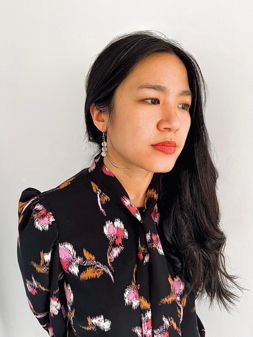 Marianne Chan grew up in Stuttgart, Germany, and Lansing, Michigan. She is the author of All Heathens, which was the winner of the 2021 Great Lakes Colleges Association New Writers Award, and Leaving Biddle City. Her poems have appeared in POETRY, The Best American Poetry, New England Review, The Kenyon Review, and Michigan Quarterly Review. She is an assistant professor of creative writing at Old Dominion University and teaches poetry in the Warren Wilson College MFA Program for Writers.