


The Desertion Bureau / White Noise
by Erika Meitner
No message from you for
months & months. Late spring
Vermont dusk where power &
phone lines cut the sunset
mountains like staves waiting
for notation. At this house
filled with artists, the air is
redolent with June lilacs, &
a sculptor in residence carved
one marble stair with the phrase
love was possible, past tense.
Your body was a place of
shelter & possibility, your absence
an album scratch, skip upending
movement, sending the tone arm
back & back into a divot.
Rivet & spit. Click & repeat.
You only have to say yes
to the world just enough, said Mo,
a choreographer, at dinner one night.
She invited me into her studio—
a sunken, emptied indoor pool
lined with marble to watch her
dance the same piece twice
to different scores: the first filled
with placid chimes & bird song;
the next, undertone recordings.
of melting glaciers. In her head
there are twenty more dancers
on stage. They’ll ritualistically
huddle, then disperse, bodies
orbiting & grazing one another
with delicate tension. You know
that time will pass & you’ll go
forward into the future, she says
while her arms arc overhead like
a setting sun, palms outstretched
in offering, duet with a ghost—
though there isn’t a sense of
knowing what the future will be—
& your embargo, your stillness,
this insoluble radio silence, your
hush, your static, your dead air:
How many ways can I sing us
together? How many ways
can you disappear?
.
This poem was inspired by many things, and I’m not sure I can stitch them together to create a cohesive narrative as much as list them and then let people read the poem to see how I wove them together.
I was at Marble House Project, a giant rambling mansion that’s been turned into a multi-disciplinary artist residency in the Green Mountains of Vermont, for a few weeks one June.
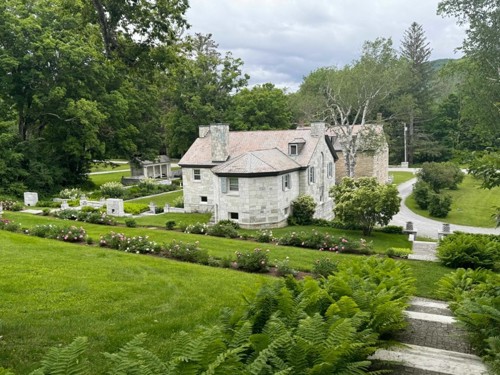
The house was built in 1815 entirely from marble harvested on Sanford Quarry, which is located on the property, and the grounds are striking and lined with marble everywhere.
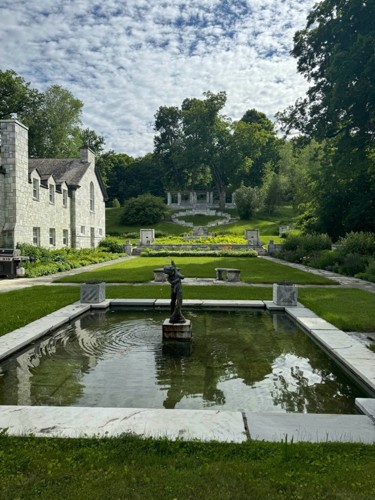
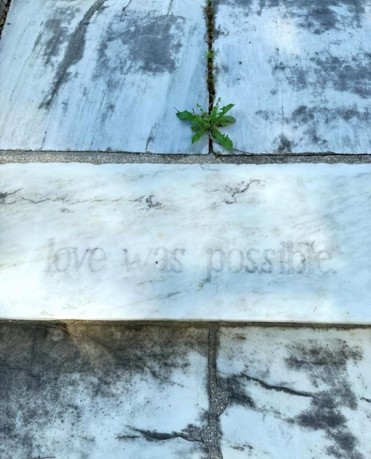
I took long walks every day down the roads there and through the grounds. There were small art installations scattered around the property, including this message carved into one of the marble stairs outside: “love was possible.”
Something about the past tense and the period just undid me every time I stepped over it.
We were a motley crew of eight artists across disciplines, and one of the artists was the choreographer Molissa Fenley. One day she asked if any of us wanted to come to her studio—a sunken empty indoor marble pool on one side of the mansion—to see her develop one of her dances, and so I did. I think all of us might have gone at one point or another to watch her dance her piece-in-process.
Every time I walked down the backroads in Dorset, I noticed the phone lines and power lines, which always looked like music staff paper to me against the sky, and wondered what conversations were running through them. I like listening to NPR when I walk, but often got gaps due to lack of cell reception there—ersatz radio silence.
My sister and her partner are therapists, and work from home a few days a week doing virtual therapy. When I stay with them, at a certain time they close the doors to the rooms they’re working in and turn on white noise machines.
About a year later I stumbled on an exhibit at YIVO Institute for Jewish Research called “The National Desertion Bureau,” which chronicled an agency of the same name, created in New York in 1911, to track down runaway Jewish husbands and bring them to justice.
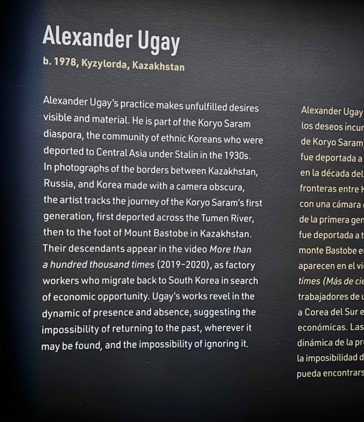
One of the visual artists at Marble House, Diana Spungin, took us to Mass MoCA for a friend’s exhibit opening: Chris Doyle’s “The Coast of Industry.” There were many artists on display there, but I snapped a photo of the gallery text for work by Alexander Ugay—unfulfilled desire, presence and absence, the impossibility of returning to the past.
On the way to North Adams, Melisa Tien, a playwright and librettist and lyricist, asked if we could stop off at her friend the composer’s place—an old Victorian that served as a residency for refugee and immigrant artists, called Floating Tower, across from the museum—which at that time had a few Ukrainian artists in residence who had fled the Russian invasion.
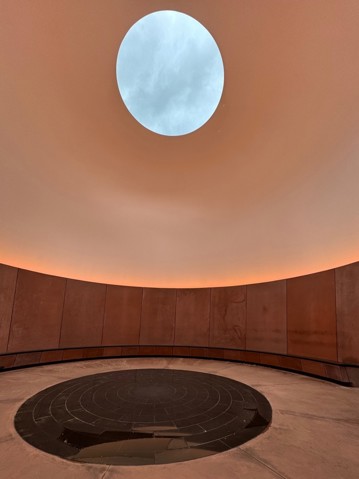
We don’t get to choose when people vanish or die, when we might have to flee a country of origin, when loss strikes us. Almost exactly a year after that trip, Diana messaged our residency What’sApp group to tell us her friend Chris—the artist whose work we had gone to see—had passed away suddenly. Mass MoCA is also home to James Turrell’s largest free-standing circular Skyspace in North America (“C.A.V.U.”). “I can make the sky any color you choose,” said Turrell, about his piece, which is the opposite of this poem. Diana and I sat in the Turrell for a long time watching the sky change colors.
.
 Erika Meitner is the author of six books of poems, including Ideal Cities, a 2009 National Poetry Series winner; Holy Moly Carry Me, winner of the 2018 National Jewish Book Award and a finalist for the National Book Critics Circle Award in poetry; and Useful Junk. Meitner is currently a professor of English at the University of Wisconsin-Madison. Her newest book of poems, Assembled Audience, is forthcoming from Milkweed Editions in September 2026.