


Reasons Not to Go
by Arah Ko
It’s hard to leave with _______ blooming. The smell of what _______ planted filling my lungs. When the sirens come, I hear my _______ beg me to pack my bags. For my _______ I might have gone, but my _______ needed me. _______, I know I promised you I’d survive to blossom in another land, but my _______ can’t yank up roots so easily. Maybe years from now, my _______ will wonder why I didn’t flee. Of course I want to live. Hold _______. I feel the oppressor’s boot crush my soil. My _______ wilting before my eyes. But what can I say? Reasons not to go fall from my lips like _______, petrichor rain, planted seeds: Because it took years for _______ to grow. Because there was no coming back. Because my _______ and _______ left and I never saw them again. Because this is my home loam, dust of my ancestors. Because of my _______. Because there was nowhere else to go. Because my _______ and _______ were buried there, and I wanted to be buried with them.
persimmons / olives / plums / peppers / grandmother / grandfather / mother / father / children / sister / brother / neighbor / son / daughter / partner / lover / poppies / camellia / rhododendrons / nettles / yarrow / wild thyme / chamomile / [insert any flora] / [insert my loved one’s name]
.
Over the past years, I have been reading innumerable stories about forced migrations in the Ukraine, Lebanon, Sudan, and the Gaza Strip, to name only a few. To escape the deadly circumstances of war, many sacrifice everything—possessions, livelihood, identity—to survive as refugees. But others elect to remain, no matter the cost. I read about Fatema Obaid, who, at 95, refused to evacuate Gaza City, saying “in this Nakba, we have lost an entire history.”
Growing up in Hawai'i, I watched many locals displaced from their ancestral homeland due to the extreme cost of living and tourism, feeling extremely conflicted about my own role in occupying the islands.
Rooted in all of these is, for me, is a lineage that did choose to go. My halmeoni and halabeoji grew up under Japanese occupation and through the Korean War. My halmeoni's family travelled on foot as refugees from what is now North Korea to Busan where she lived in a refugee camp and her father begged food from the US base for the camp families. Later, he was accused of being a communist and tortured for three days near Namsan Tower in Seoul. This experience made him decide to bring the whole clan to the Americas, where they settled in the US and Panama. In many ways, this event is why I write poems in English today.
The reality is, there is a profound cost whether you stay or go. This poem attempts—and inevitably fails—to try and name why it is not as simple as "just leaving" dangerous circumstances, and I hope it inspires some empathy towards others regardless of their decision.
.
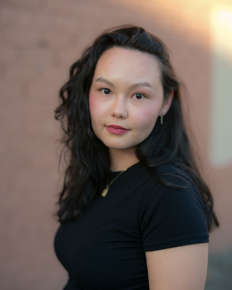 Arah Ko is a writer from Hawai'i and PhD student in creative writing at the University of Cincinnati. She is author of a poetry collection, Brine Orchid (YesYes Books, 2025), and a chapbook, Animal Logic (Bull City Press 2026). Her work is published in The American Poetry Review, Ninth Letter, The Threepenny Review, Poetry Northwest, and 32 Poems.