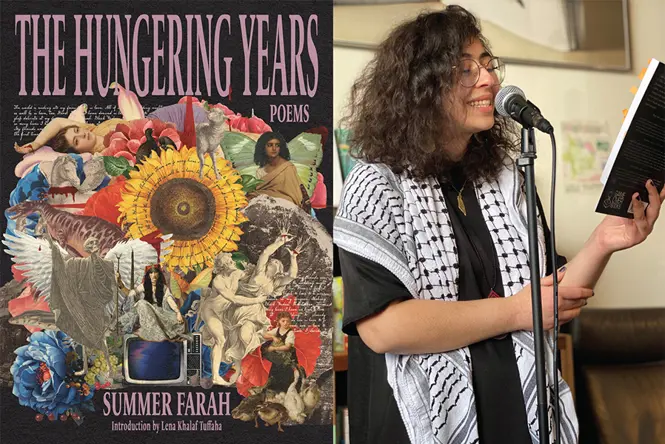
“If the world is ending I want to be unafraid,” Summer Farah writes in her debut poetry collection that succeeds in firmly holding the reader in its world and startling them page after page. Exploring themes of sacrifice and love, remembrance and return, fear and yearning, as well as violence and devastating loss, The Hungering Years is both a fierce and unwavering witnessing and a desperate plea for healing and hope.
Tryphena Yeboah: Because the collection begins with the poem “Reading Mary Oliver in La Verne,” I think it is only right that we begin with our mutual love for Mary Oliver. A few days ago, I shared her poems “Mysteries, Yes” and “Don’t Hesitate” in a letter to a friend. Do you recall when you encountered Oliver's poetry for the first time?
Summer Farah: Not the first time, no—she’s so ubiquitous! Truthfully, for a while I felt a lot of apathy towards canonical or popular white poets. A lot of young marginalized writers probably felt this way to some extent, that there wasn’t much they could offer me. I was wrong! Even if I don’t connect with something, it can spark something. Lack of connection, though, is not the case with Mary Oliver. I’d read her poems in the sort of live-laugh-love way, you know? Excerpted, decontextualized, maybe even disrespected.
I didn’t engage with her seriously until I engaged with her playfully. I had a vision one day, maybe in 2020 or 2021, of a booming voice saying: What is it you plan to do with your one wild and precious life, while the moon from The Legend of Zelda: Majora’s Mask floated menacingly. And so I made that little image, and then I got obsessed with overlaying profound Mary lines onto screenshots from video games, lines from a few other poets, too, but mostly Mary. It was fun, it was silly, but eventually I ran out of poems online and was gifted Devotions. I stopped engaging for the sake of playing around—instead, I read to really read. I felt attuned to the questions she was asking. Mary demonstrates an intense attention that transforms place into company and challenges the reader to pay attention in return. What have you noticed today?
I’ve had a very fraught relationship with the outdoors, with exercise, movement. It rained the day before Mary’s birthday in 2022, and my parents’ neighborhood was still damp the next morning. It had been so hot and gross that summer, so the rain was a wonderful prize. Everything looked greener, lusher, saturated. I read from Devotions that morning and was compelled to take a walk for the first time in what felt like years; maybe pathetic, but I remember that walk making me feel like I was alive for the first time. I wanted to have the companionship of the world the way Mary did in her poems.
TY: A reader does not have to get far into the collection to see your fascination with Lebanese-American poet Etel Adnan. Your 2024 chapbook, I could die today and live again, also engages with Adnan’s work. Some poems felt like private confessions to Adnan, and it was delightful to be introduced to her writing. I would love to hear more about your engagement with her work, how it has deepened over the years, and what it’s been like to have her as a muse in your creative practice.
SF: Initially, I struggled with her work. The first book I sat down and read seriously, rather than excerpts shared on social media, was Surge. It felt too far away for me to understand, but I wanted to, because I knew she was important—both to Arab American letters in general, but also to people who I loved, people who inspired me, to the organizations that held my work. I began collecting her books, looking for her whenever I was at a bookstore. I thought that physical, location-based connection would strengthen my relationship to the work. It wasn’t until In the Heart of the Heart of Another Country that she really clicked. She was a weird girl! She saw the vibrations of the universe! She carried a lot of guilt and despair because of distance, she rendered the horror of mundanity while we live within a violent place so profoundly. After that, I felt more ready to learn from her—even though the process leading up to that point had already taught me patience and a beautiful relationship to the unknown. Once you learn from someone, you want to let them know how you’ve honored those lessons.
TY: I recently read Omar El Akkad’s One Day, Everyone Will Have Always Been Against This, and I kept thinking about his critique of silence in the face of the ongoing genocide of Palestinians, the lack of accountability and moral courage, and how easy it is for us to look away when we’re safely distanced from the pain of others. In many ways, your writing of these poems is an active resistance, a voice breaking through the silence.
SF: I don’t consider my work resistance. I worry that my work can even become pacification. If there’s something moving in my work that leads someone to dissent, to refuse, to resist, then I am grateful! But the poem itself—from someone of my position!—is not resistance. It’s a different question from writers in different conditions; I think about Dareen Tatour, the Palestinian writer who shared a poem on her Facebook in 2015 called “Qawim ya sha’abi, qawimhum” (“Resist My People Resist Them”) that led to her arrest. A lot of writing on Palestine coming from the U.S. is pacification—that to simply point to something, from a voice that is not very scary, is suitable work for the day. To validate how sad we all are. I write from my body, from my feelings, from what I see; the poem is political because my body is political, my feelings are shaped by that what is around us, and the gaze and what it notices is political. The first step is to admit this, but I don’t find admitting that to be particularly herculean. I don’t think our first instinct when faced with atrocity should be to write poems to be shared. I’m shocked by the speed of publication of some books about Gaza, particularly by people not from Gaza. I am disgusted by the obviousness with which so many titles released in 2025—a year I was intentionally reading new releases from Southwest Asia and North Africa writers for a project with Samia Saliba—were by non-Palestinians who surely had their proposals drafted by November 2023. This is not to say only Palestinians should write on the genocide. I appreciate work by people like Mary Turfah—whose medical expertise and historical knowledge contextualizes violence in Gaza and Lebanon, and I would argue, gives us better tools to organize—and poets like June Jordan that have work that continues to resonate, reminding us that the struggle is not new. But, in other instances, opportunism is clear. I encourage us all to be more discerning with the writing we cling to; political education is important to building a better world—what world is the author inviting us to imagine? Who is no longer part of it?
TY: What is your first instinct when faced with atrocity, particularly that of others?
SF: Writing is a great way of processing, engaging, learning—I don’t mean to say the instinct is inherently bad, nor do I want to imply the way I respond to crisis is good or correct! But, I generally ask myself: What can I do for others? Different types of advocacy—protests, organizing in workplaces, community patrols, locating and contributing to mutual aid or trusted charities, it all depends on context. And these feel useful, to a point. Sometimes the sharing of a poem can offer a point of connection, though, and that’s good—there are an abundance of harms to work through each day. I recommend spending time on Mizna’s online platform to see work from writers from Gaza and Sudan, but for collections, I am always talking about Batool Abu Akleen’s 48kg!
TY: When you look back on the writing and editing process, what surprised and challenged you as you put these poems together? Was there an aspect of the collection that changed significantly?
SF: A few weeks ago, Lorde released drafts/demos/notes for her album Virgin. It was a really beautiful listening experience—the many iterations of each track, from a voice note quality to the beginnings of the final production evident, hearing lyrics tweaked and prodded until they sat correctly in her mouth. I love repetition and so hearing the same song in different forms over and over again was so pleasing to my brain. While I listened, I flipped through my notebook and revisited the hand-written first drafts of the Etel Adnan series; I remembered viscerally the night I had written the poems, five flowing out of me in immediate succession, and you can see that quickness in the sloppiness of my already-awful handwriting. I didn’t always handwrite first drafts, so it felt like I was holding something precious, preserved.
Some of the poems changed a lot—“AFTER WE WATCH ROADFOOD I CONSIDER PLACE,” was much sillier in its first iteration, but found its true form after October 7th. Others were almost word-for-word the same. I had evidence of the many attempts at getting “AFTER MOUNT TAMALPAIS, I TELL ETEL ADNAN ABOUT SUPERNATURAL” right, one of the most personally important poems I’ve ever written. This was all prior to my publishing process with Host Publications, though. The second “I TELL ETEL ADNAN ABOUT SUPERNATURAL” poem was the last one I added to the book, after I signed with Host. I had to go to Mount Tamalpais before I was able to write it. Its addition made me reflect on how strange it was that I could have imagined the book finished without it.
TY: What about its organization?
SM: The main question I went back-and-forth on when ordering the collection was whether to group the Etel Adnan poems together in their own section—like Wendy Xu’s “We Are Both Sure to Die” section in You Are Not Dead—or have them scattered throughout the book, like Hanif Abdurraqib does with several series in Fortune for Your Disaster. Those were the two collections I was taking structural inspiration from. But I knew I wanted “ROADFOOD” to end whatever project it was part of, whether it was a zine or a full-length collection, and so it became working backward from that. If “ROADFOOD” ends the narrative, how are the other poems in the series limited by this proximity to the end of the text? Do they build momentum? Is it better to let them exist throughout, instead? I worked that out before my submission to Host, but the order still changed significantly during our editorial process. We went from two sections to three, put poems I had originally conceived in Part I in Part III, and on. But “ROADFOOD” stayed the last poem. “READING MARY OLIVER IN LA VERNE” as the first poem was a last-minute swap, originally it was “I TELL ETEL ADNAN ABOUT MITSKI.” I thought “For months, I ate as if it was performance” was a better first line. I had spent so much time thinking about the poems as whole objects when ordering, until the very last minute.
My editor, Claire, had saved ordering for the last step precisely because of how lines can change in the editorial process, but I hadn’t really internalized that until review copies were already with folks. There are poems that transformed significantly—like “PORTRAIT OF A LADY ON FIRE,” a poem I would have cut had Claire not said “If you do anything with this poem before cutting it, maybe consider making it less” which worked (you can see an older version of it in a folio edited by Saba Keramati for Westbranch) or “PELVIC FLOOR PHYSICAL THERAPY” which was originally a much less complex form before, again, gentle nudging from Claire. Claire is the best! Those bigger changes shape how I’ve approached the next phase of my writing and editing—it feels like I’ve said the first and second layer of what I needed to say in The Hungering Years. Now, revising poems is less tightening what flowed out naturally and, instead, attempting to uncover the third and fourth layer of meaning, which I think “PELVIC FLOOR PHYSICAL THERAPY” is a model of. I’ve been leaving a lot of complicate this? comments for myself. I want to have an of archive of those shifts, the way I felt when listening to Lorde’s XRAYS, so I’ve been handwriting more. The topics haven’t changed much, but hopefully how I communicate them will.
TY: In the poem “(DEAR ETEL ADNAN) I DON'T THINK OF CARLY RAE JEPSEN,” you write, “Sometimes I am in love with the almost knowing of poetry. I tell others, don’t worry if you don’t understand; truthfully, I pray for obscurity.” Can you speak to this invitation to sit in the silence, the unknown, particularly when it comes to engaging with a piece of art?
SF: Since that poem is so much about learning to know Etel’s work, I’ll use some of her words, from a conversation with Laure Adler collected in The Beauty of Light. She says, about the act of painting: “The fact of not knowing isn’t discouraging…You get pleasure from not knowing.” There’s a lot of freedom in admitting you don’t understand something. I think about how satisfying it is to solve a difficult puzzle in a video game instead of looking it up, to let process and repetition linger in you until it clicks, like now your body has inhabited that mindset long enough for it to be part of you. How it feels to read a poem for the hundredth time and notice something new, so then you feel something new. The unknown trains a new muscle for recognition.
TY: I love what you’ve done with form here. I am thinking of poems like “THE BEAUTIFUL MEN” as well as the prose and blackout poems. What writers or teachers have influenced how you think about the shape of a poem?
SF: “THE BEAUTIFUL MEN” was informed by the frenetic space and generous caesura that I learn from poets like Safia Elhillo or Aziza Barnes—Barnes, in particular, had these really momentous prose poems that were so effectively populated with space. I admire torrin a. greathouse who is a great experimenter—“PELVIC FLOOR PHYSICAL THERAPY” uses the burning haibun, an adapted form of her invention. I’m someone who is afraid of a lot of established forms. I really love how Ariana Brown approaches teaching form, prioritizing how form works for us. I was reading Leila Chatti’s Wildness Before Something Sublime during my editing process, which is all about play and experimentation—its precision guided how I attended to the final pass of my poems and how I’ve approached my writing since.
TY: We have to talk about titles because they are hard to miss with each page turn! “LISTENING TO OLIVIA RODRIGO ON A PLANE TO SAN DIEGO, OCTOBER 2021”; “PORTRAIT OF ME AS A BREAD BAKING IN JERUSALEM”; “IF THE WORLD IS ENDING, I WANNA GO DOWN DANCING,” etc. What are the stories of how some of the titles came about?
SF: “IF THE WORLD IS ENDING, I WANNA GO DOWN DANCING” comes from a paraphrased line from the film Gloria Bell, a movie I have not seen! But you might see poems with variations on that title from other Arab American writers that I bounce around with. At Wet Hot Arab American Summer, a writing workshop hosted by the Radius of Arab American Writers in 2019, Hazem Fahmy told us extensively about that movie, for some reason? And that line, specifically. I truly cannot remember why. But a group of us were really enamored with the sort of drama and glamour of the sentiment and made a rough pact to write poems to it. A few weeks after the workshop, I was thinking about the summer I had had—not just at RAWI, but seeing other long-distance friends at a wedding, the concerts I had been to with people I did not often see, and on, and how lucky I was to have friends in so many corners of the world, and how much I missed them all of the time. The long title felt appropriate to capture the abundance that the poem became. In general, I love a long title! It is a little goofy and I like making people laugh. It gives the poem a looseness before going in, while still situating us precisely. I enjoy the first line being the title, too. Let’s just dive in!
TY: To steal a line from “A YEAR AFTER I FIRST LOVED HAIKYUU!!,” what art has invited you to treat yourself better? And what art has invited you to consider care as inherent to craft?
SF: I love this question! I’ll start with Haikyuu!!; it’s a manga/anime about volleyball. There’s a stunning scene where the protagonist gets a fever during his high school national championship. He is too sick to keep playing because he’d been pushing himself too hard. His coach sits him down and says, I know it sucks to have to stop, but remember this feeling, and how badly you want to keep going, and know that resting and prioritizing your health is also volleyball—you can’t sustain your craft if you can’t sustain yourself.
There’s Sundus Abdulhadi’s Take Care Of Yourself, which engages critically with the notion of care and how it operates within movement and art spaces. I read this book, as well as Fariha Róisín’s Who is Wellness For? the same year as Haikyuu!!—the three operated surprisingly well together, three pillars of helping me think through how I was treating myself and how it impacted my ability to do good for others. It’s taken a long time to internalize the lessons that I took from Haikyuu!!, but a mantra—“working until being okay has become habit” really resonates with me. I am trying very hard every day. I’ll add a more recent one—I saw Maddie’s Secret a few days ago, the John Early film about an up-and-coming recipe developer whose eating disorder relapses because of the stress and attention. Maddie displaces her issues with food onto her creative career, which is something I’ve done (in The Hungering Years) and so of course everything suffers when you lose the illusion of control. There’s a grounding sentiment delivered by Early as Maddie, that she didn’t want someone she cared about to treat themself the way that she treats herself. An inversion of treat others the way you want to be treated. Care for yourself the way you want your loved ones to care for themselves. Don’t substitute work with legitimate rest—and unfortunately, like craft, rest is something you have to practice at, too.
TY: Wrap-up list of Poets and Poems that have stayed with you over the years:
A poet you’ll read anything by: Trish Salah
Two poets who inspire you: Chase Berggrun and Fargo Tbakhi
A poem you know by heart (or wish to know by heart): “We Are Both Sure to Die” by Wendy Xu that begins, “But I feel like a person again.”
Two nightstand poetry collections: Currently, Party Line by Kyle Carrero Lopez and Thalassa by leena aboutaleb.
A collection you’ll read again and again: Kingdom Animalia by Aracelis Girmay
A poem for summer: Leila Chatti’s “I Went Out to Hear”
A poem for a hard season: Lena Khalaf Tuffaha’s “Letter to June Jordan in September”
A poet you’ve recently discovered: I read Turning to Fiction by Donna Masini recently, the first time I’d read anything by her, recommended by my friend Maria Gray who is her student, and it feels silly to say I “discovered” an incredibly established and accomplished poet, but now I’m like, Wow, everyone, you gotta read Donna!!!! I think, especially if you vibe with the way pop culture and art is used throughout The Hungering Years, Turning to Fiction would be your jam.
Two poems we should read after reading this interview: “From the River to the Sea” by Samer Abu Hawwash, translated by Huda Fakhreddine and “For My Sisters Who Entered The Nile With Open Eyes” by Umniya Najaer.
Summer Farah is a Palestinian American writer, editor, and zine-maker from California. She is the author of I could die today and live again (Game Over Books, 2024), poems inspired by The Legend of Zelda. Her debut full-length poetry collection, The Hungering Years, was published with Host Publications in February 2026. She sends out the occasional essay, mostly about Supernatural, at eveningconversations. Currently, she lives in Los Angeles, pursuing a PhD in Creative Writing & Literature at USC.
Tryphena Yeboah is the author of A Mouthful of Home (Akashic Press, 2020). She teaches English and creative writing at Tennessee Wesleyan University.