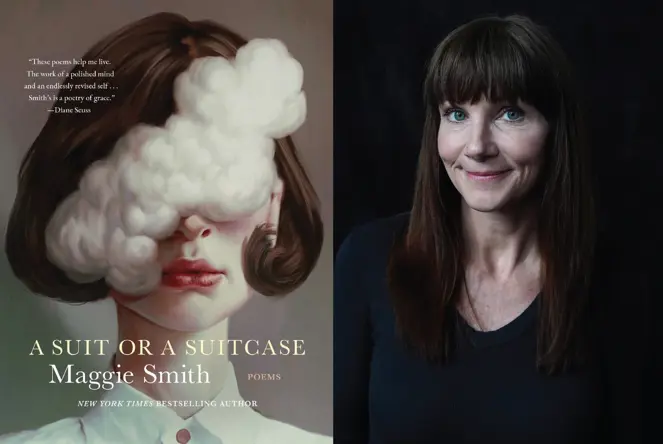
I was first introduced to Maggie Smith’s poetry when I read her poem, “Good Bones.” I do not remember where I was or how I came across it, but I do remember clinging to its last words, “You could make this place beautiful.” For a poem that lays bare the brutalities that mark the world, the reader is startled by Smith’s invitation of beauty, her hope for restoration.
There’s more room to hold the world’s despair and hope, its grief and joy in Smith’s new collection, A Suit or a Suitcase, as the poet turns an inward eye to the shifting landscapes of the self. With incisive and tender language, Smith interrogates the body—how it widens and collapses, empties and fills, as it moves through the past, all the while straining against the weight of memories.
Smith writes in “Beside Myself”:
With each breath I’m pulling
myself together. Cinching
the threads. Oh little shadow,
falling away from me,
come back. Oh self,
crayoned outside the frame,
come back, come back.
A Suit or a Suitcase is a door cracking open, the kind of homecoming that beckons you to stay.
Tryphena Yeboah: How does writing change the way you see the world and the way you see yourself?
Maggie Smith: I’ve been writing since I was in middle school—my son’s age now—so I hardly remember processing experience without writing. I’m not sure who I’d be if I hadn’t discovered poetry as a teenager. But as an adult, I’ve brought my life to the page, the joy and grief and confusion, and finding a shape for those experiences has been foundational for me. Writing helps me contextualize. It gives me perspective. Writing makes my life more legible to me.
TY: In A Suit or a Suitcase, you write about the self—and the multitudes that exist within—with such candor and wonder. Can you talk about the risk of vulnerability in your writing and if this has always been an intentional choice?
MS: Vulnerability doesn’t feel like a choice. I think we have to be vulnerable when we write, but that doesn’t mean we have to say or show everything to the reader. I’m an open person, on the page and off, but there are still parts of my life I keep to myself. If I hold something back, it’s because I value privacy, and in particular the privacy of other people in my life. The balance between vulnerability, honesty, and privacy is something I think about a lot, both in poetry and in nonfiction.
TY: I loved coming across questions in the poems: “How do I get back inside myself?” or “What can I carry forward except these reminders?” Was there a guiding question that was important for you to capture on the page?
MS: I think each poem brought its own set of questions and concerns with it, and that’s what was important for me to capture. What is the speaker grappling with? How do I find the language to articulate that? When I write, I’m having a conversation with my mind on the page, so each poem is, in a sense, a translation.
TY: You write beautifully about nostalgia and memory, change and movement, and the dance between the past, present, and beyond. What do you remember about writing these poems? Are there particular moments of surprise that have stayed with you?
MS: Thank you for the kind words, first of all! Most of the poems in A Suit or a Suitcase were written between 2020 and 2024, but a few were written years earlier and a few were written more recently. This is always the way: I write one poem at a time, and I write slowly, so years pass before I have accumulated enough poems to start thinking about whether I have a book. But when I return to the poems, I do remember the inspiration, and I recall parts of them coming together in revision. Each poem has its own origin story. The newest poems in the book are “Document” and “This human life,” both of which were added to the manuscript in 2025. Those late, late-breaking poems were a wonderful surprise! I’m always delighted when a poem unexpectedly knocks at the door.
TY: In “You Ask If I Believe in the Afterlife,” you write: “If I’m wrong / about the afterlife, I say, I’d want to be / a sun-dappled stereo. My own mind / playing song after song, a hell of a score.” What is your relationship with music and does this overlap in any way with your writing?
MS: Music is the artform I engage with the most, even more than poetry. I listen to music all day long, depending on what my schedule looks like. (Obviously I can’t listen to music while recording a podcast, or doing a book event onstage, but while writing, and showering, and driving, and walking the dog, and cooking, and folding laundry? Yes!) The overlap with writing, really, is that music is what led me to poetry. I started writing poems before I started reading much poetry, but I was already a huge music fan as a young person, and I listened to songs over and over, trying to understand the lyrics. I think that’s where it all began for me.
TY: What would you say to people who want to be more creative?
MS: I am constantly learning and unlearning my own limitations. In the last few years I’ve been traveling beyond my comfort zone, which is poetry, and venturing into essays, memoir, children’s books, and fiction. Sometimes I lose my nerve, as we all do now and then, and I have to remind myself that writing is writing, and I can learn what I don’t yet know, and I just have to keep going. I need my own pep talks sometimes!
TY: A catalog of poets and poems that have stayed with you over the years:
A poet you’ll read anything by: Matthew Zapruder
A poet that inspires you: Victoria Chang
A poem you know by heart: “The Jewel” by James Wright
Two nightstand poetry collections: The Collected Poems of Stanley Plumly and the latest collection by Lauren Camp, Is Is Enough
A collection you’ll read again and again: Song by Brigit Pegeen Kelly
A poem for summer: “Sun In Days” by Meghan O’Rourke (this is a poem for all seasons, and it’s heartbreaking, but it has such gorgeous summer imagery)
Two poems for a hard season: Rilke’s “Go to the Limits of Your Longing” and Kim Addonizio’s “To the Woman Crying Uncontrollably in the Next Stall”
Two poems for a good season: anything by Saeed Jones or Gabrielle Calvocoressi
A poet you’ve recently discovered: Lisa Low
Two poems we should read after reading this interview: any two poems recently featured on The Slowdown!
Maggie Smith is an award-winning New York Times bestselling author of poetry and prose and the host of The Slowdown. Her books include A Suit or a Suitcase (Washington Square Press, 2026), Goldenrod, Keep Moving: Notes on Loss, Creativity, and Change, Good Bones, The Well Speaks of Its Own Poison, and Lamp of the Body. Smith’s poems and essays have appeared in Best American Poetry, The New York Times, The New Yorker, The Paris Review, Ploughshares, The Washington Post, The Guardian, and elsewhere Smith has received fellowships from the National Endowment for the Arts, the Ohio Arts Council, and the Sustainable Arts Foundation.
Tryphena Yeboah is the author of A Mouthful of Home (Akashic Press, 2020). She teaches English and creative writing at Tennessee Wesleyan University.