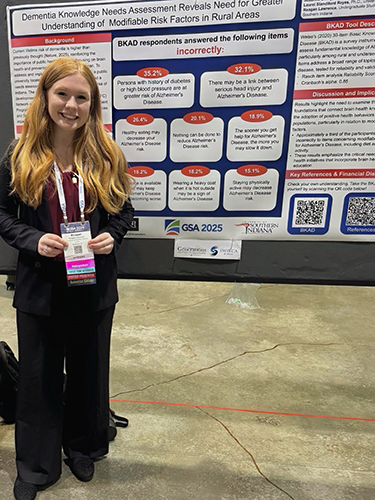
 Reagan Lawrence, a biology major, pre-med student and GWEP research assistant, is the recipient of the 2026 USI Trustees Distinguished Merit Award. She plans to graduate in May of 2027, and also has two minors: Interdisciplinary Gerontology and Medical Humanities.
"Being nominated, when I am aware there are hundreds of other deserving students, meant a great deal to me," she says. "One of the most meaningful lessons this recognition has highlighted is that sustained effort, even when the outcome is unclear, truly matters. Working, volunteering and pursuing this major have all been significant undertakings. There were many moments when I could not see the immediate results of my work, which is especially hard in a society of instant gratification. But this award has shown me that perseverance does pay off, even when the impact is not visible right away!"
What inspired you to choose biology as your major and pursue a pre-med track? My love for science was seemingly innate, as was my passion for medicine. I do not recall ever answering “what do you want to be when you grow up” with anything other than doctor (maybe author here and there). Albeit the reason propelling me toward this field has been dynamic and ever-changing. These reasons have evolved from caring for my grandmother with early onset Alzheimer’s to watching my aunt battle cancer. Fulfilling this dream of being a doctor, along with a fascination for science that was further cultivated at the Medical Professions Academy in high school, I chose biology on a pre-med track!
How did you first get involved with the Geriatrics Workforce Enhancement Program (GWEP)? Being a first-year student with more free time on my hands than I knew what to do with, I decided to begin volunteering. Knowing the impact hospice had on my family, I began volunteering with Compassus Hospice. I visited my first patient in the last year of his life. Over this time, we glanced through his memory book, listened to classics and more. Around 5 months into our visits, he stopped talking completely. However, we found new ways to connect, through a playlist of 70’s rock with Bohemian Rhapsody at the center. This year of weekly visits and connection sparked an interest in aging. With this newfound interest, I spoke to my advisor, Dr. Delaney, who recommended that I take GERO 215, which is embedded in the core 39 curriculum. It was through this class that I met Dr. Katie Ehlman (former director of the Bronstein Center for Healthy Aging and Wellness) and was offered a job at the GWEP!
Can you share a project or experience from GWEP that had the biggest impact on you? Over the past year and a half of working with the GWEP, I’ve had many experiences that have been deeply impactful. One of these experiences occurred recently while I was in Boston to present research at a conference. I attended a session led by individuals living with various types of dementia and their care partners, and it powerfully highlighted the need to shift our perspectives on dementia. Many people view dementia as the end of life, “dying with dementia.” However, this is far from accurate. “Living with dementia” reflects the reality much better. This session resonated with me so strongly that I have since connected with the Alzheimer’s Association and one of the panelists. During the Spring 2026 semester, I helped plan a session for students, staff and community members who are interested in flipping the script and changing their own perspectives on dementia.
What have you learned about caring for older adults through your research assistant role? In terms of older adult care, I have gained insight into an friendly care model called the 4Ms, which emphasizes how the pillars of mobility, mentation, medication, and what matters can meaningfully enhance the lives of older adults. One “M” that is sometimes easy to overlook in medicine is the what matters, which can range from the patient’s favorite drink to understanding their end-of-life wishes. For example, my grandma’s “what matters” would have been a Dr. Pepper! In my future career, I hope to carry forward this insight into the complexity of caring for the whole person and use it to improve the lives of my patients. Although this care model was designed with older adults in mind, it is applicable to people of all ages!
How do you see this experience shaping your future career in medicine? Through this experience, I have met so many incredible people and gained valuable skills. I learned how to delegate tasks, step into leadership roles when needed, and ask for help when I am at capacity! Additionally, this experience, especially the example set by the leaders I work with, has taught me to always strive for improvement. If I see something that could be better, I have learned to take initiative (ask my supervisor) and get to work. These lessons are valuable in medicine and life.
What advice would you give other students who want to get involved in research or community health initiatives? Perhaps one of the things I say most is “The only thing I am rich in is time.” So, if you have a passion for research or community health initiatives, use your time to make an impact on these areas. As college students, there are so many opportunities to get involved on and off campus so do it! And when you do get involved, do not be content with only 50% effort. Give everything you do your all, as this can truly make a difference in the lives of the people in our community (and you never know where it can lead you).